
UK Greyhound Betting Tips: Strategy, Form & Winning Methods
 Available in US
Form analysis, trap draws, bet types and value strategies for UK greyhound racing.
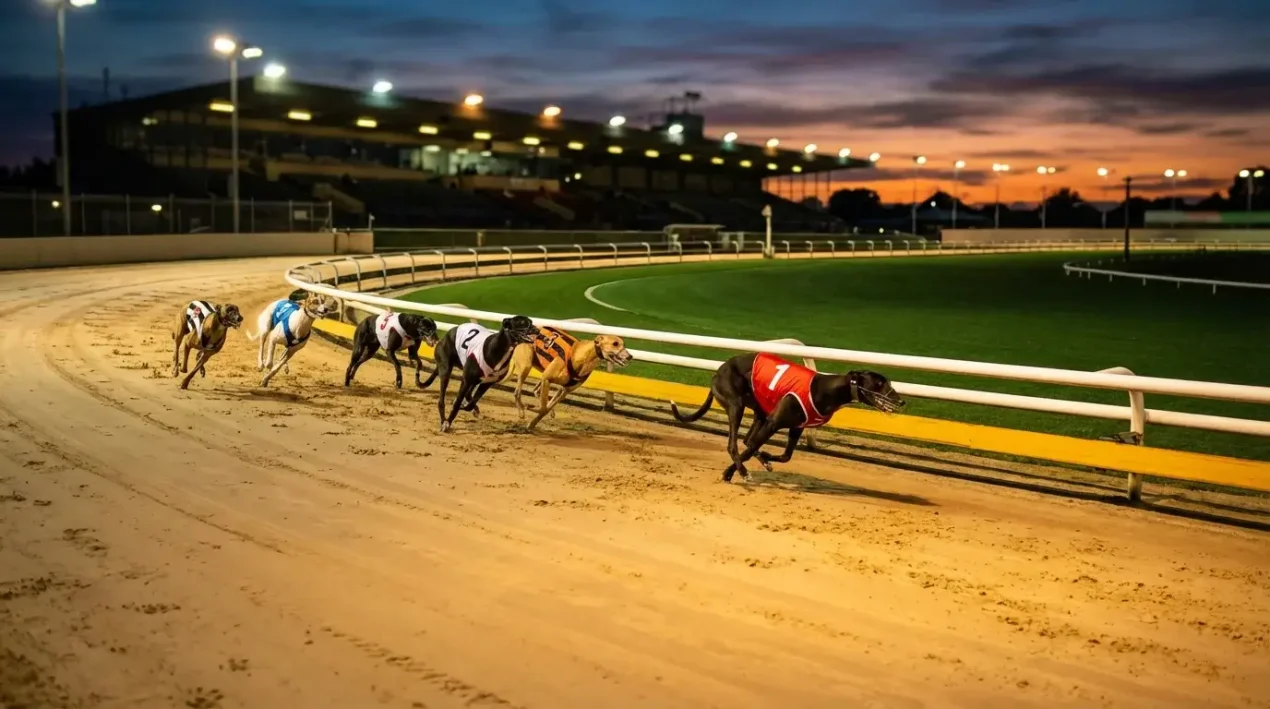
Why Greyhound Betting Rewards a Different Kind of Punter
Horse racing dominates the headlines, but the real edges live in the dog track margins. Football markets are dissected by thousands of analysts and algorithms. Horse racing attracts professional syndicates and institutional-level data operations. Greyhound racing, by comparison, exists in relative analytical silence — and that silence is where opportunity lives.
The UK greyhound betting market is less efficiently priced than almost any other sport you can legally wager on. There are several reasons for this. The fields are small — six runners per race — which sounds simple until you realise that bookmakers still build in margins of 15 to 20 per cent on a six-dog field. The form data is publicly available but rarely interrogated with any depth. And the sheer volume of racing — over 60 GBGB-sanctioned meetings every week, each featuring 12 races — means the bookmaker's tissue compiler is spreading attention thinly across hundreds of races a day. That is where a focused punter gains ground.
The Greyhound Board of Great Britain regulates all licensed racing across England and Wales, currently overseeing 18 registered stadiums. Racing happens almost every day of the year, split between evening meetings broadcast on Sky Sports Racing and daytime BAGS fixtures carried on SIS. The sport is marking its centenary in 2026 — one hundred years since a greyhound named Mistley won the first regulated race at Belle Vue, Manchester, on 24 July 1926 — and the GBGB has responded with an expanded open race calendar featuring 50 Category One competitions and 27 Category Two events across the season. If you are looking for betting volume, there is no shortage.
But volume alone does not create profit. This guide is built for the punter who wants to move beyond gut feel and daily tip lists. It covers form analysis, trap draws, bet types, strategy construction, and value identification — everything needed to bet on greyhounds with a framework rather than a hunch.
UK greyhound racing at a glance: There are 18 GBGB licensed tracks in England and Wales, hosting over 60 meetings per week with typically 12 races per card. Racing is broadcast daily via Sky Sports Racing, SIS, and RPGTV, with most bookmakers offering live streaming to funded accounts.
Reading Greyhound Form: What the Numbers Actually Tell You
A greyhound's race card is a compressed biography — you just need to know where to look. Every line encodes a set of decisions that the market has already attempted to price, and your job is to decide whether the market got it right. The race card is your primary research tool, and learning to read it properly is the single most important skill in greyhound betting.
A typical UK greyhound race card displays information in a consistent format across all GBGB tracks, though the exact layout varies slightly between providers. The core data points for each runner include: trap number and colour (red, blue, white, black, orange, and black-and-white stripes for traps one through six), the dog's name, its trainer, recent form figures, best time over the race distance, sectional time to the first bend, current racing weight, and the grade of the race.
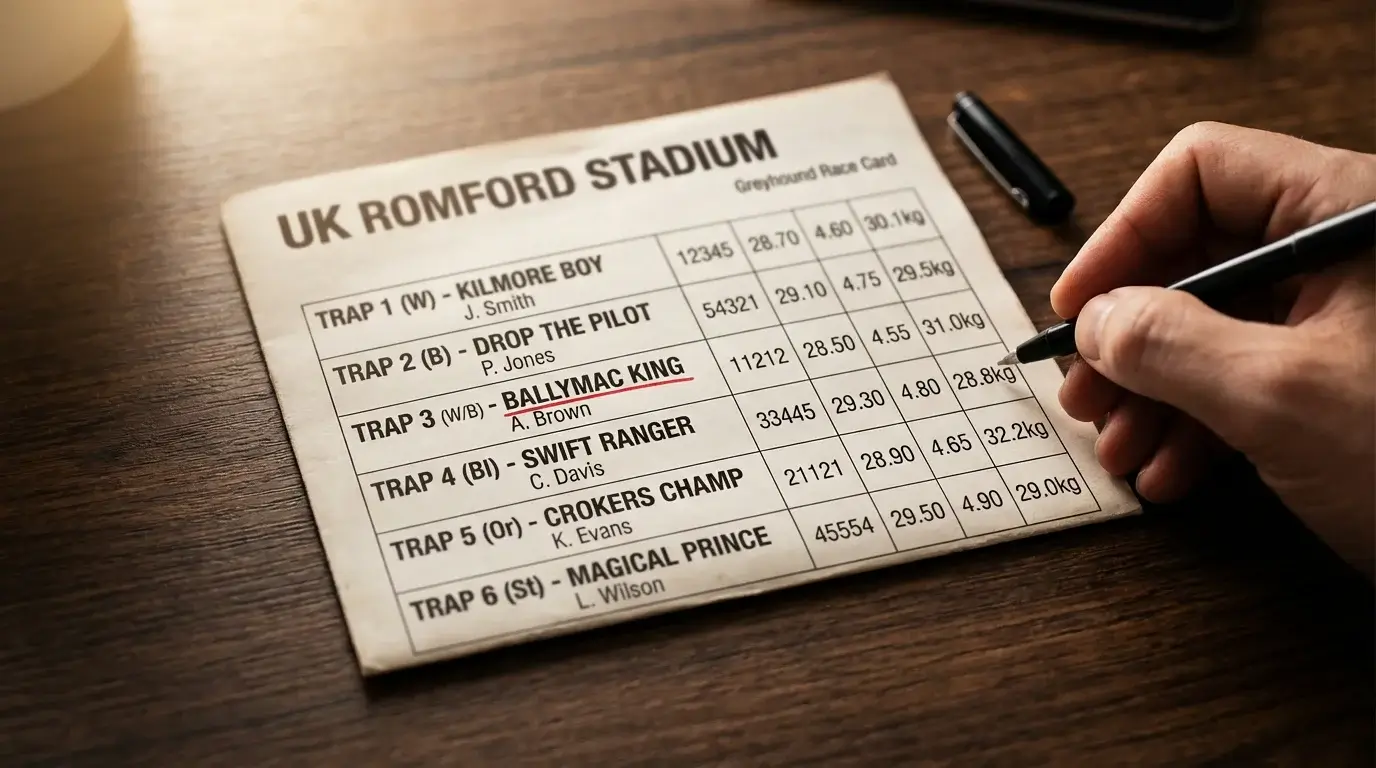
The trainer's name is listed alongside each runner and carries more analytical weight than most casual punters give it. In the 2025 season, Mark Wallis claimed his record sixteenth GBGB Trainer of the Year title, finishing on 2,090 points — over a thousand clear of second place. Trainer form is not a curiosity; it is a data point that reflects kennel condition, training quality, and the ability to peak a dog for a specific race. When a leading trainer enters a dog at a track it rarely visits, or drops one in grade after a trial, that is a signal worth noting.
The best time column shows the fastest recorded run for that dog over the race distance at the track. Useful, but deceptive if taken at face value — a best time may have been set months ago in different conditions: faster going, a strong pace to chase, or a clean run from a favourable draw. The more revealing figure is the sectional time.
Sectional time — the time recorded from the traps to the first timing point, usually the first or second bend, which measures a dog's early pace and ability to find a clean racing position before the field compresses.
Decoding Form Figures and Run Positions
Each digit in a form string carries weight — position, distance beaten, and track context all compressed into a single character. UK greyhound form figures record finishing positions across the dog's most recent runs, read from left to right with the oldest run first. A form line reading 321146 tells you this dog has been gradually declining after a strong sequence, then bounced back to win before fading again. That is not a random sequence; it is a narrative.
The numbers one through six represent finishing positions. A zero means the dog did not finish, typically due to interference or a fall. Letters embedded in the form string add context: W indicates the dog ran wide, M means it raced in the middle of the track, Bk signals it was baulked (impeded by another runner), SAw denotes a slow away from the traps, and F or Fell records a fall. These are not footnotes — they are explanations for poor form that might otherwise look like decline.
Reading form sequences demands pattern recognition more than individual race analysis. A dog showing 111234 is a declining former winner — the question is whether it has hit a ceiling in its grade or encountered specific problems that the form letters explain. A dog showing 653211 is improving, and improving dogs in greyhound racing are the most consistently underpriced runners in the sport. The market tends to price on recent headline results. The punter who reads the form string as a direction of travel — not a snapshot — has an immediate analytical edge.
Pay particular attention to the track codes attached to each run. A form figure earned at a tight, sharp track like Crayford is not equivalent to the same figure at a galloping track like Nottingham. A dog that finishes third at an A2 graded race at Hove is running against stronger opposition than one finishing first in A5 at a less competitive venue. Grade, track, and form figure must be read as a unit, not in isolation.
Weight Trends and Race Fitness Signals
A two-pound swing looks minor on paper until it turns a front-runner into a fader. Weight is the one variable on the race card that changes between every start, and it is also the one most punters glance at and ignore. That is a mistake. In a sport where the difference between first and fourth can be less than a length, physical condition is decisive.
The acceptable weight fluctuation for a fit, racing greyhound is generally in the range of 0.5 to 1.0 kilogram between starts. A dog racing consistently at 30.2kg that suddenly appears at 31.4kg has either been rested (and possibly over-fed during the layoff) or is carrying a condition issue that is not immediately visible. Either way, it is not the same dog the market priced last time out.
Weight loss can be equally informative. A small drop — 0.2 to 0.4kg — between closely spaced runs often indicates nothing more than normal racing exertion. But a sustained downward trend across three or four starts sometimes signals overracing, particularly in older dogs or those running twice a week in BAGS meetings. The race card will show you the trajectory if you bother to track it.
Race fitness is related but distinct from weight. A greyhound returning from a break of more than three weeks will have a trial on its card, typically at a shorter distance. The trial time gives a fitness baseline but should be interpreted cautiously — trial conditions lack the competitive pressure of a race, and dogs returning from layoffs are statistically less likely to win, particularly in higher grades where margins are thinnest.
Greyhounds lose roughly 0.5kg per race from exertion alone — a 2kg gain between starts warrants investigation, because the dog has not simply been sitting idle.
The Trap Draw: Why Box Position Shapes Every Race
Six traps. Six colours. And a first bend that eliminates half the field before the back straight. The trap draw is the single most underappreciated variable in greyhound betting, and the punter who ignores it is essentially flipping a coin with bad odds.
Every greyhound race in the UK is run around an oval track with bends, and the first bend is where races are won and lost. A dog drawn on the inside — traps one or two — has the shortest distance to travel to the first bend, which is an advantage for railers, dogs with natural early speed that hug the inside rail. A dog drawn wide in trap five or six has further to travel but more room to manoeuvre, which suits wide runners that need space to find their stride. The middle traps, three and four, are the most ambiguous — they can produce clean runs or absolute chaos depending on the early pace of the inside and outside runners.
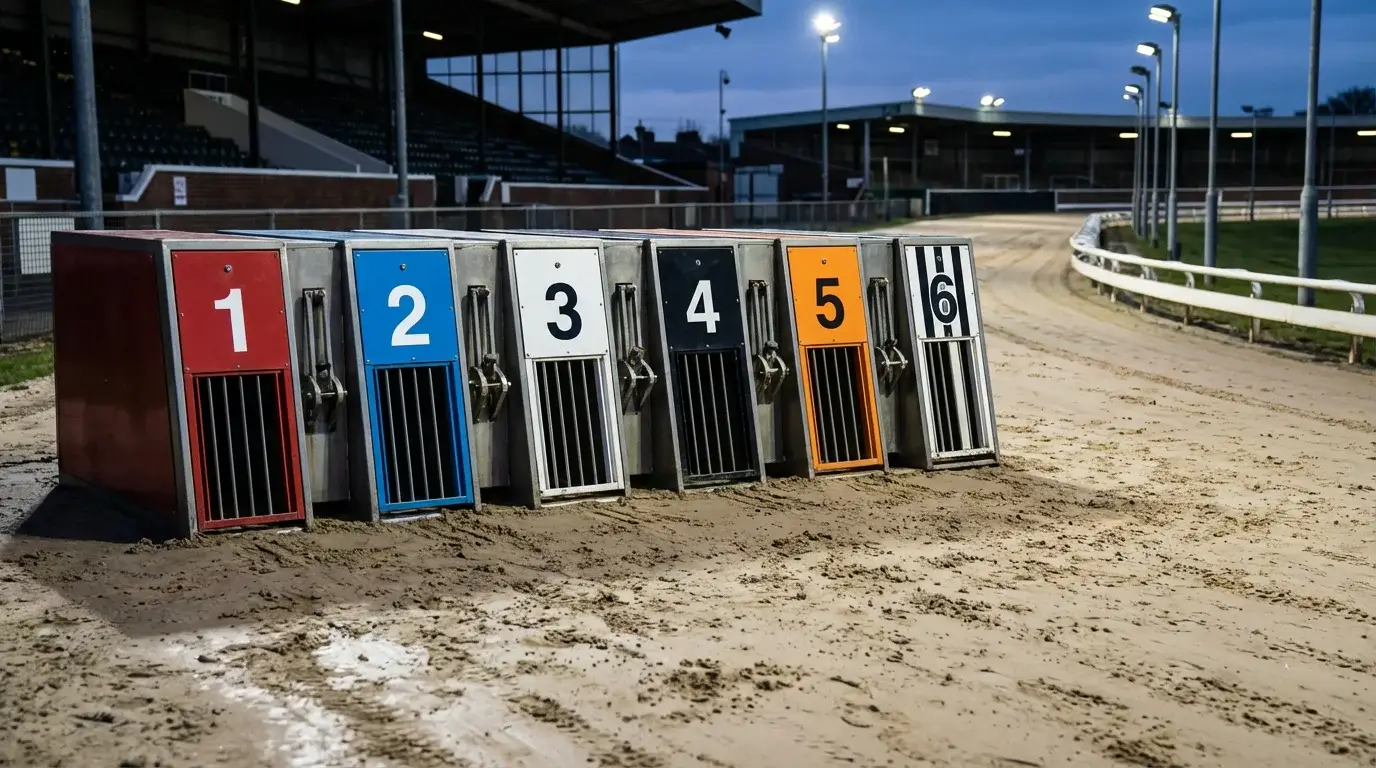
In graded racing, trap allocation is seeded. The racing manager assigns dogs to traps based on their known running style — railers go inside, wide runners go outside. This seeding produces cleaner races and means the draw itself is informational: a dog in trap one has been assessed as a railer by the racing office.
Open races are different. The draw is typically random, which creates mismatches. A confirmed wide runner drawn in trap one faces an immediate tactical problem. A front-running railer drawn in six has to cross the field. These mismatches are where alert bettors find value the market overlooks.
Trap bias is real and track-specific. At some venues, trap one has a measurably higher win percentage than the field average over large sample sizes. At others, trap six outperforms because the track geometry favours wide runners. The key is not to generalise — the phrase "inside traps are best" is a myth that costs punters money. What is true is that certain traps are best at certain tracks, over certain distances, and for certain running styles.
Example: A6 Graded Race — Romford 400m
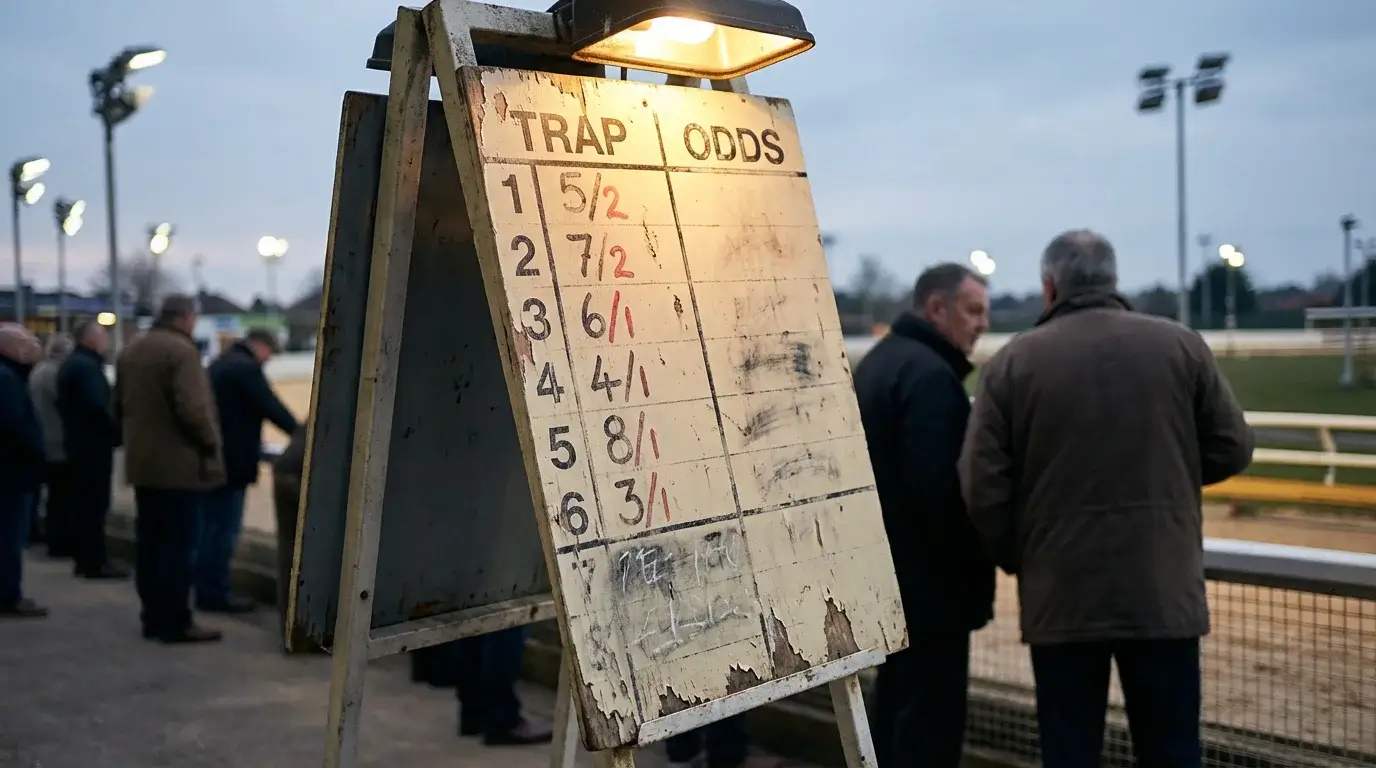
| Trap | Dog | Odds |
|---|---|---|
| 1 Red | Ballymac Dozer | 5/2 |
| 2 Blue | Droopys Hawk | 7/2 |
| 3 White | Highview Sandy | 6/1 |
| 4 Black | Kilara Donut | 4/1 |
| 5 Orange | Swift Cleo | 8/1 |
| 6 Stripes | Priceless Cargo | 3/1 |
The favourite is drawn in trap one — a railer seeded on the inside, with a fast sectional and a clear path to the first bend. Trap six is priced at 3/1 despite being a confirmed wide runner with strong finishing speed. The question for the bettor: does the market correctly price the advantage of trap one at Romford's tight first bend, or is the wide runner undervalued because its closing speed can overcome the draw?
Core Bet Types for Greyhound Racing
Before thinking about strategy, nail the mechanics — what you are actually betting on. Greyhound racing offers a range of bet types that stretch from the completely straightforward to the genuinely complex, and understanding the structure of each one is not optional. A punter who places a forecast without understanding how the dividend is calculated is gambling on a mechanism they do not control and cannot evaluate.
The core bet types in UK greyhound racing fall into three categories: singles and each-way bets, forecast and tricast bets, and multiples. Each has a different risk profile, a different expected return, and a different strategic application. Some are suited to graded racing where form is more reliable; others come alive in open races where the field is more unpredictable and the dividends more generous.
What follows is a breakdown of each type, starting with the simplest and building towards the combinations that experienced greyhound punters use to extract value from races that the market has not priced efficiently. The key principle throughout is this: every bet type is a tool. The question is never whether a forecast is better than a win bet — it is whether this specific race, with this specific field, suits a forecast or a win bet. Context dictates everything.
Win, Place and Each-Way Bets
A win bet is the simplest transaction in racing — one dog, first past the post. You back a greyhound to win the race at the offered odds, and if it finishes first, you collect. If it finishes anywhere else, you lose your stake. There is no ambiguity and no complication. It is also the bet type with the lowest house edge, because the bookmaker's margin is spread across fewer outcomes than in exotic bet types.
Place betting in greyhound racing works differently from horse racing. In a standard six-runner field, the place terms are typically first and second at one quarter of the win odds. A dog priced at 8/1 for the win pays 2/1 for the place.
Each-way betting combines a win bet and a place bet in a single wager — two equal stakes. If your dog wins, you collect both dividends. If it finishes second, you lose the win portion but collect the place payout. Each-way works best at 5/1 or longer, where the place return covers a meaningful portion of your total outlay.
A practical example: a two-pound each-way bet at 6/1 costs four pounds total. If the dog wins, you collect twelve pounds (win) plus three pounds (place at 6/4), totalling fifteen for a four-pound stake. If the dog finishes second, you collect five pounds from the place portion (three pounds in winnings at 6/4 plus your two-pound stake returned), meaning a net profit of just one pound on the four-pound outlay. The maths is simple; the strategic question is whether that 6/1 shot genuinely has a higher chance of finishing in the first two than the market implies.
Forecasts, Tricasts and Combination Bets
Forecasts reward precision; tricasts reward conviction — and both reward patience. These bet types are where greyhound betting separates from the casual punter's realm and enters territory that demands genuine analytical work.
A straight forecast requires you to predict the first and second finishers in the correct order. In a six-runner race, there are thirty possible first-and-second combinations (six possible winners multiplied by five possible second-place finishers), which gives you a rough sense of the difficulty involved. The dividend is calculated by the Tote or bookmaker based on the actual finishing order and the weight of money staked on each combination, which means forecast dividends are not fixed odds — they are pooled. A winning forecast on two outsiders can return substantial amounts, while a forecast involving the first and second favourites might return surprisingly little.
A reverse forecast covers the same two dogs but in either order, doubling your combinations and your stake. Combination forecasts extend the principle: select three or more dogs, and the bet covers all possible first-and-second pairings among them. Three dogs create six combinations, so a one-pound combination forecast costs six pounds.
Tricasts require the first three finishers in exact order — 120 possible permutations in a six-runner race. The dividends reflect that difficulty: a successful tricast on three mid-priced dogs can return fifty to a hundred times your stake. Reverse tricasts cover all six permutations of your three selections across the first three places, costing six times your unit stake.
The strategic question is not whether you can predict exact orders — nobody does that consistently — but whether specific races produce conditions where the likely finishing order is more constrained than the market expects. A race with three closely matched dogs and three clear outsiders narrows the realistic combinations significantly, and that is where forecast and tricast betting finds its edge.
Building a Greyhound Betting Strategy That Survives Contact with Reality
Systems fail. Edges erode. What survives is a repeatable process built on honest data. That sentence should be taped to the screen of every punter who has ever searched for a greyhound betting system, because the uncomfortable truth about betting strategy is that the system is not the edge — the discipline around the system is.
A greyhound betting strategy is not a set of rules that tells you which dog to back. It is a framework for making decisions under uncertainty, recording those decisions, and evaluating them honestly over a meaningful sample size. The punter who backs three dogs on a Tuesday night and declares the strategy broken by Wednesday has not tested anything — they have participated in variance.
The foundation of any workable strategy starts with specialisation. The UK has 18 licensed tracks, each with its own distances, trap biases, grading structures, and racing calendars. Attempting to follow all of them is a recipe for shallow analysis and inconsistent results. The punters who show long-term profit in greyhound betting almost universally specialise in one or two tracks. They know the grading patterns, the trainers, the typical pace of each distance, and the dogs currently moving through the grades. That depth of knowledge is not replaceable by a generic system applied across every meeting.

The second pillar is record-keeping. If you are not recording every bet — the selection, the price, the reasoning, and the outcome — you have no way to distinguish between a bad strategy and a bad run. A spreadsheet takes five minutes to maintain and eliminates the single biggest source of self-deception in betting: selective memory.
Third is an honest relationship with data. A strategy based on backing early-speed dogs from trap one at Romford only works if you test it against at least 200 historical results. Anything less and you are fitting a narrative to noise. Most strategies that look profitable over 50 bets revert to the mean over 500. The ones that survive are worth committing to.
Price discipline ties the whole framework together. A dog can be the right selection and still be a bad bet if the price is wrong. This is the hardest concept for most punters to internalise, because it requires walking away from a race you have analysed thoroughly simply because the odds do not offer sufficient return for the risk. That restraint — the ability to pass on a bet — is the single strongest predictor of long-term profitability.
Do
- Specialise in one or two tracks and learn them deeply
- Record every bet with selection, price, reasoning, and result
- Take early prices when you identify value — do not wait for SP
- Set a daily and weekly loss limit and respect it without exception
How to Identify Value in Greyhound Markets
Value is not about picking winners — it is about finding prices that overestimate the losers. That distinction sounds academic until you run the numbers. A punter who backs 100 dogs at 3/1 and wins 30 of them has a 30 per cent strike rate, which sounds mediocre. But at 3/1, that strike rate produces a return of 120 units on 100 staked — a 20 per cent profit on turnover. The selections do not need to be brilliant. The prices need to be wrong.
Identifying value in greyhound markets begins with estimating your own probability for each runner. This does not require a mathematical model, though one helps. It requires an honest assessment: given the form, the draw, the weight, the trainer, and the track conditions, what is the rough percentage chance this dog wins the race? If you assess a dog at a 25 per cent chance of winning, that equates to a fair price of 3/1. If the bookmaker is offering 5/1, you have a value bet. If they are offering 2/1, you do not, regardless of how much you like the dog.
The concept of an overlay — a bet where the offered price exceeds the dog's true probability — is the engine of profitable greyhound betting. Estimating true probabilities is imprecise, particularly in a sport where first-bend interference can turn a 40 per cent chance into an also-ran. This is why sample size matters. A single value bet can lose. A hundred value bets placed at prices exceeding your estimated probability will produce a profit if your assessments are even approximately correct.
Greyhound markets produce overlays more frequently than horse racing markets for structural reasons. The market is thinner — fewer punters, less sophisticated analysis driving the odds — and the bookmaker's tissue price is based on form algorithms that do not always capture context. A dog returning from a layoff with a good trial, drawn in a favourable trap, at a track where the racing manager has seeded the field in its favour, might be priced at 5/1 because the algorithm sees two recent defeats. Your assessment, incorporating factors the algorithm underweights, puts it at 3/1. That gap is where the money is made.
Staking and Bankroll Discipline
The fastest way to lose a betting bank is to bet like you have already lost it. Staking discipline is not glamorous, it does not produce viral screenshots, and nobody on a forum ever celebrated a level-stakes plan. But it is the reason some punters are still betting in year five while others burned through three banks in year one.
The professional baseline for greyhound betting is to stake between one and two per cent of your total bankroll per bet. On a 500-pound bank, that means five to ten pounds per selection. The logic is mathematical, not emotional. At one per cent staking, you can absorb a losing run of 20 consecutive bets and still retain over 80 per cent of your bank. At five per cent staking, the same losing run reduces you to 36 per cent. And 20-bet losing streaks are not hypothetical in greyhound racing — they are a statistical certainty over any meaningful sample of bets.
Level staking — the same amount on every bet — is the simplest and most robust approach. It removes the temptation to increase stakes after a winner or a loser. Percentage staking, where you recalculate your bet size based on your current bank, is slightly more sophisticated and automatically reduces exposure during losing runs. Both work. What does not work is variable staking based on confidence, because human confidence in betting selections is a terrible predictor of outcome.
Loss limits are the related discipline. Setting a daily cap — say, three per cent of your bank — and stopping when you hit it is recognition that losing sessions distort judgement. The most damaging sessions in any account are not the ones where you lost three bets at level stakes. They are the ones where you lost three and then doubled up twice trying to recover.
Interactive Tool
Weekly Race Volume, and Staking Gap Comparison
Multiply out the UK's true weekly race count, and see the exact bankroll gap between 1% and 5% staking after a losing run.
Total Races per Week
-
-
Meetings/Week
-
Races/Card
-
Daily Average
-
What this guide leaves as two unconnected numbers: "over 60 GBGB-sanctioned meetings every week, each featuring 12 races." The total is never multiplied out — that's 720 races a week, or roughly 103 a day across the UK.
Retention Gap
-
-
1% Staking Retains
-
5% Staking Retains
-
Ratio
-
What this guide states separately but never compares: "At one per cent staking, you can absorb a losing run of 20 consecutive bets and still retain over 80 per cent of your bank. At five per cent staking, the same losing run reduces you to 36 per cent." The direct gap is never stated — it's 45.9 percentage points, meaning 1% staking preserves 2.28x as much bank as 5% staking after the identical losing run.
Important: Never chase. If your process is correct, the variance resolves. If it is incorrect, doubling down makes it worse. Either way, increasing stakes in response to losses is the wrong move.
Track Knowledge: The Edge Most Punters Ignore
A dog's sectional time means nothing until you know the track it was clocked on. This is the lesson that separates casual followers of greyhound racing from punters who actually understand what the numbers on a race card represent. UK greyhound tracks are not standardised — they vary in circumference, bend radius, distance availability, surface condition, and the type of hare used. Each of these variables affects race dynamics, and a dog's performance at one track does not automatically translate to another.
Track circumference is the most obvious difference. A tight, sharp track like Romford, with a circumference of around 350 metres, produces races where early speed and a clean run to the first bend are decisive. The bends come quickly, the field compresses early, and dogs that cannot find a position by the first turn are often shuffled back beyond recovery. Contrast that with a galloping track like Nottingham, with more generous bends and longer straights, where dogs with strong finishing speed can make up ground on the run-in and closing pace carries more weight than trap position.
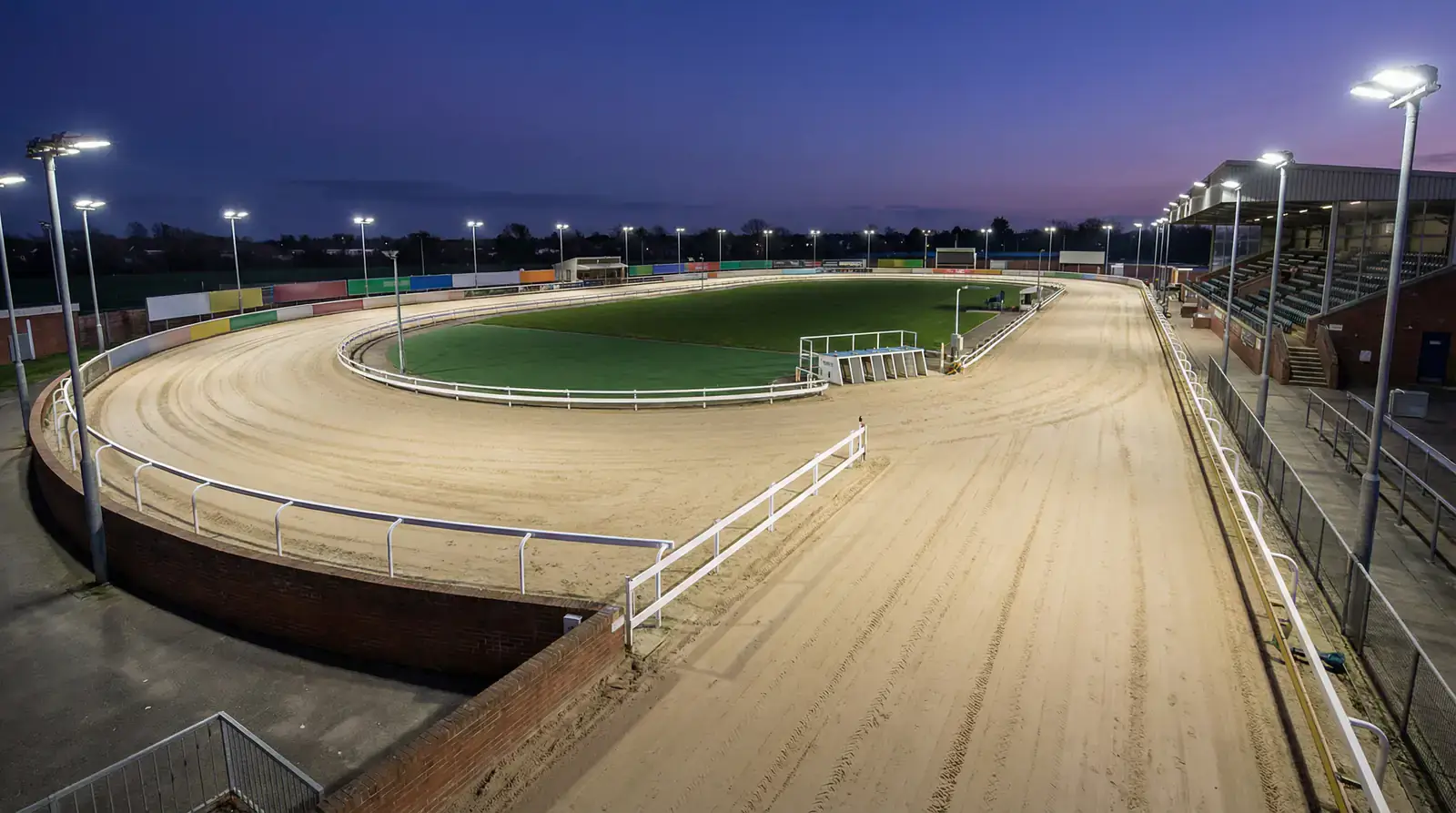
Pace bias is track-specific and measurable. At some venues, front-runners win a disproportionate share of races because the track geometry punishes dogs that lose ground at the bends. At others, the configuration is more forgiving and closers have a genuine chance. Understanding which profile applies at your chosen track is not optional — it determines which form figures you prioritise, which trap draws matter most, and which running styles produce consistent results.
Going conditions add another layer. UK tracks use sand-based surfaces, and speed varies with weather. A rain-affected track runs slower, which can compress the field and reduce the advantage of early-speed dogs. A fast, dry surface amplifies the gap between quick starters and those that need time to find their stride. Check conditions on the day via the track's social media or the racing broadcast.
The practical advice here is straightforward: pick one or two tracks and learn them properly. Know the distances offered, the trap bias at each distance, the typical race grades on each night, and the trainers who regularly feature. A punter who knows Romford inside out will find more value in six races at that track than in twenty races spread across five venues they barely understand.
| Romford | Nottingham |
|---|---|
| Tight, sharp bends — suits railers and early-speed dogs | Wider bends, longer straights — suits closers and dogs with stamina |
| Distances: 225m, 400m, 575m | Distances: 305m, 480m, 500m, 680m |
| Strong inside trap bias at 400m — trap one consistently outperforms | More balanced trap stats — wider runners competitive at most distances |
| Fast pace early, races often decided by the second bend | More gradual pace, finishing speed carries greater weight |
| Evening meetings on Sky Sports Racing; popular BAGS venue | Regular evening and daytime BAGS cards; SIS coverage |
Understanding Greyhound Odds and Market Movements
Greyhound markets are thinner than horse racing, and that cuts both ways. The lower volume of money flowing through greyhound betting markets means prices are less efficiently set — creating more frequent opportunities for value, but also more volatility, sharper price movements, and less liquidity on exchanges. Understanding how greyhound odds are formed, how they move, and when to take a price is as important as understanding the form itself.
Greyhound odds start with the tissue price, an initial estimate of each runner's probability compiled by the bookmaker's odds team. For high-profile open race meetings, the tissue reflects a degree of genuine analysis. For the majority of BAGS meetings — the daytime fixtures that make up the bulk of UK greyhound racing — the tissue is generated algorithmically, based on recent form figures, trap draw, and grade. These algorithm-driven prices are where the most frequent pricing errors occur, because they cannot capture context the way a knowledgeable bettor can.
Early prices are offered by most major bookmakers in the hours before a race and frequently differ — sometimes substantially — from the Starting Price. The SP is determined by on-course bookmakers at the point the traps open and reflects the final weight of money in the market. For the value-conscious punter, the choice between taking an early price and waiting for SP is one of the most consequential decisions in greyhound betting. The 2026 GBGB racing calendar, packed with centenary-year Category One events, has already produced several instances of significant early-price value on open race heats where the market has underestimated less fashionable kennels against established names.
Best Odds Guaranteed is a promotion offered by several bookmakers that pays you the higher of the early price you took or the SP, whichever is greater. When available for greyhound racing — not all bookmakers extend it to dogs — it removes much of the risk from early-price betting. You take the price, lock in your value, and if the market drifts further in your favour, you benefit anyway. It is effectively a free option, and any punter not using it when available is leaving money on the table.
Exchange markets via Betfair and Smarkets offer an alternative to bookmaker pricing. Exchange liquidity in greyhound markets is lower than in horse racing, which means prices can be lumpy. However, the absence of a built-in bookmaker margin means exchange prices are generally closer to true probability, and the ability to lay — bet against a dog winning — opens strategic approaches unavailable with traditional bookmakers.
In greyhound racing, the edge is not in the selection — it is in the price. A correct selection at the wrong price is a losing bet. A marginal selection at a generous price is a long-term winner.
Errors That Quietly Drain a Greyhound Betting Account
Nobody goes broke on a single bad bet — they go broke on the habits around it. The errors that drain a greyhound betting account are rarely dramatic. They are quiet, repetitive, and almost invisible until you look at the spreadsheet at the end of the month and wonder where the money went. Here are the ten most common.
Betting with emotion instead of analysis. Backing a dog because you like its name, its colour, or its kennel is not a strategy. Every bet should be traceable to a specific analytical reason — form, draw, price, track bias. If you cannot articulate why you are betting, you should not be betting.
Ignoring the trap draw. A dog with outstanding form drawn in the wrong trap at a track with strong bias is no longer the same proposition. The trap draw modifies every other factor on the card, and dismissing it because the form looks good is one of the most common and most costly errors in greyhound betting.
Chasing losses. The session is going badly. The rational response is to stop. The instinctive response is to increase stakes and try to recover. The instinct is wrong, every single time. Chasing losses is the fastest route to account destruction in any form of betting, and greyhound racing's relentless schedule — races every few minutes — makes it particularly dangerous.
Over-staking. Betting five or ten per cent of your bank on a single race because you feel confident. Confidence is not a bankroll management tool. The mathematics of ruin are unforgiving, and over-staking collapses a bank faster than bad selections.
Ignoring non-runner impact. When a dog is withdrawn, the remaining field dynamics change. A non-runner from an inside trap opens space for the next dog. A non-runner that was the expected pace-setter alters the entire race shape. Punters who do not reassess after a withdrawal are betting on a race that no longer exists.
Relying on a single tipster without understanding their method, staking plan, or verified track record is outsourcing your judgement without due diligence.
Neglecting track knowledge. Betting across five or six tracks without deep knowledge of any means every bet carries an information deficit. That is not a recipe for profit.
Not recording bets. If you do not know your strike rate, your ROI, or your longest losing run, you cannot evaluate your strategy. You are guessing — and guessing is what the bookmaker wants.
Taking SP when an early price was available. The early price is almost always the point of maximum value for a fancied runner. Waiting for SP is paying a premium for indecision.
Accumulator addiction. Greyhound accumulators are tempting because the payouts look enormous. But the mathematical reality is harsh: a four-fold accumulator on dogs with a 33 per cent individual win probability has roughly a 1.2 per cent chance of success. Accumulators are entertainment bets, not strategy bets, and treating them as a primary approach is a reliable way to fund the bookmaker's Christmas party.
Frequently Asked Questions
How often do favourites win in greyhound racing?
Across UK GBGB tracks, the favourite wins approximately 30 to 35 per cent of graded races, with the exact figure varying by track and grade. Data from recent seasons shows that in graded racing — the bread-and-butter of the daily schedule — the favourite's win rate in the A1 to A11 grades sits consistently between 30 and 31 per cent, while open race favourites perform somewhat better owing to the higher class and greater form reliability of the runners involved. What this means for bettors is that backing every favourite at SP is a guaranteed losing strategy, because the prices offered do not compensate for the 65 to 70 per cent of the time the favourite loses. Profitable favourite-backing requires selectivity — identifying the specific races where the favourite is underpriced relative to its actual chance, rather than backing them indiscriminately.
What is the best trap in greyhound racing?
There is no single best trap across all UK greyhound tracks — trap performance is entirely track-specific and distance-specific. At tight, sharp tracks like Romford and Crayford, inside traps (particularly trap one and trap two) tend to produce higher win percentages over sprint distances because they offer the shortest path to the first bend. At wider, more galloping tracks like Nottingham, the trap bias is less pronounced and outside traps can be competitive. The key is to check the trap statistics for your specific track and distance combination, which services like Greyhound Stats UK publish in detail. Betting based on a generalised "trap one is best" rule without verifying it against the actual data for the venue you are betting on is one of the most common mistakes in greyhound wagering.
Is greyhound betting profitable long term?
Greyhound betting can be profitable long term, but only for a disciplined minority of punters who approach it as a skill-based activity rather than entertainment. Long-term profitability requires deep track knowledge (ideally specialising in one or two venues), rigorous record-keeping, consistent bankroll management with stakes of one to two per cent per bet, and the ability to identify value — situations where the bookmaker's price exceeds the dog's true probability of winning. The structural characteristics of greyhound markets — thinner liquidity, algorithm-driven pricing, and less public analysis than horse racing — do create genuine opportunities for informed bettors. However, anyone expecting quick or easy returns is likely to be disappointed. The edge in greyhound betting is small, it compounds slowly, and it demands the kind of patience and analytical rigour that most casual punters are unwilling to sustain.
The Long Game at the Dog Track
Every serious greyhound punter reaches the same conclusion eventually — this is a craft, not a gamble. The difference between the two is not talent or luck. It is process. The punter who treats greyhound betting as a craft builds systems, tests them honestly, records the results, and adjusts when the evidence demands it. The punter who treats it as a gamble chases the next tip, doubles the stake after a loser, and wonders why the bank keeps shrinking.
Greyhound racing in 2026 is in a peculiar position. The sport is celebrating its centenary — a hundred years since that first race at Belle Vue — while simultaneously facing legislative challenges in Wales and Scotland. The GBGB's 18 licensed tracks continue to host racing almost every day of the year, with a Category One schedule that has never been more comprehensive. The dogs still run, the traps still open, and the markets still present opportunities for those who understand how to find them.
If this guide has done its job, you now have a framework for engaging with those markets more intelligently. You understand form beyond headline figures. You know why the trap draw matters and how track geometry shapes outcomes. You can assess bet types by strategic application, not just mechanics. And you understand that bankroll discipline is the infrastructure on which everything else rests.
None of this guarantees profit. Nothing does. But it moves you from the group of punters who fund the bookmaker's margin to the group that has a realistic chance of extracting value from it. The dog track rewards patience, specialisation, and honesty. It punishes impulsiveness, overconfidence, and laziness. Whether you choose to take that trade-off seriously is up to you. The dogs will be running either way.
