
How Greyhound Odds Are Set
 Available in US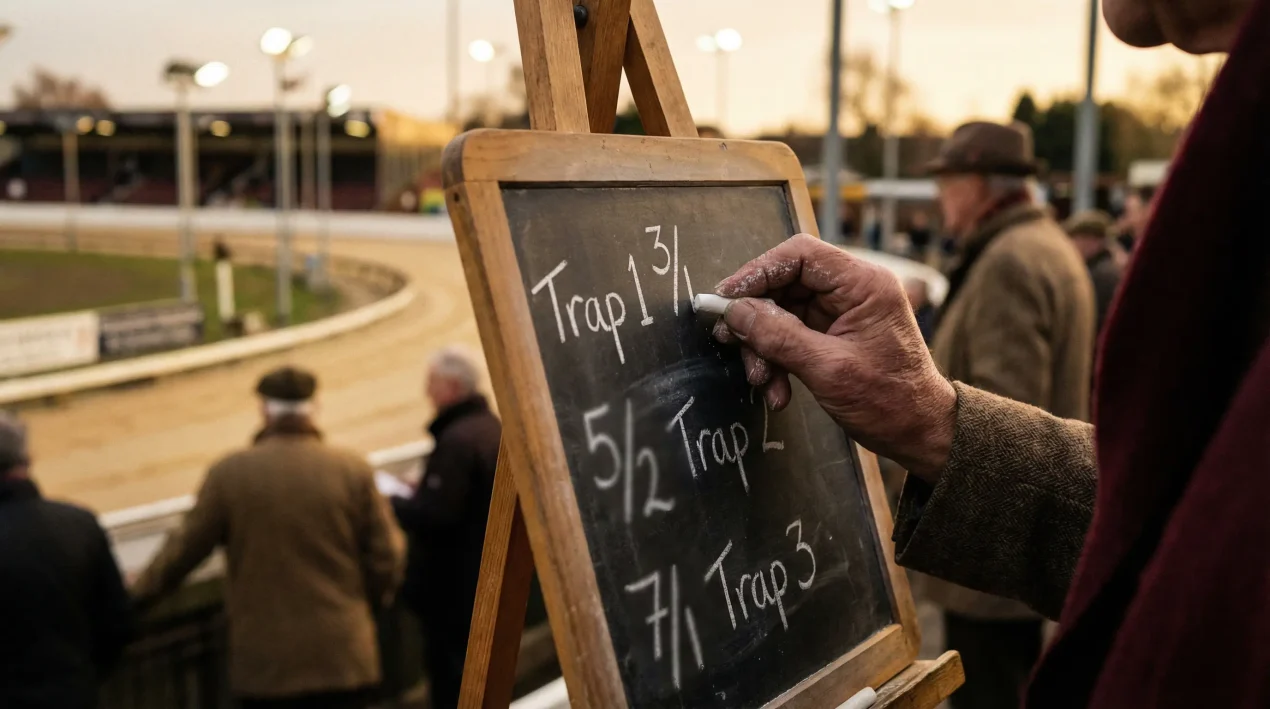
Contents
Behind the Numbers: How Bookmakers Price Greyhound Races
Every set of greyhound odds you see on a betting site began life as someone’s opinion. Before the market opens, before a single pound is wagered, a trader at the bookmaker’s office has looked at the race card, assessed the six runners, and produced a set of prices that represents their view of each dog’s chance. That initial assessment gets refined by money, but it doesn’t start with money — it starts with analysis, and understanding that process gives you insight into the price you’re being offered.
Most punters treat odds as facts. They’re not. They’re a bookmaker’s commercial proposition — an invitation to bet at terms that the bookmaker believes will generate profit across thousands of transactions. The price you see includes the bookmaker’s margin, the trader’s assessment of the race, and the distorting effect of money that has already been wagered. Learning to see through those layers is what separates punters who assess value from those who simply react to numbers.
The Tissue Price and Initial Market Formation
The first step in pricing a greyhound race is the tissue — the bookmaker’s initial set of odds, compiled before the market opens to the public. The tissue is produced by a greyhound trader, either in-house or via a specialist pricing service, and it reflects their assessment of the probability of each dog winning based on form, grade, trap draw, trainer, distance suitability and any other relevant factors.
A tissue for a typical six-runner race might look like this: 2/1, 3/1, 4/1, 5/1, 7/1, 10/1. Those prices imply probabilities — roughly 33%, 25%, 20%, 17%, 12.5% and 9% — that sum to more than 100%. The excess is the bookmaker’s margin, and it’s built into every market from the start. In greyhound racing, the tissue overround — the total implied probability across all six runners — typically sits between 115% and 130%, depending on the bookmaker and the meeting.
The tissue is not published to the customer. What appears on the betting site is the opening price, which is the tissue adjusted for commercial considerations — perhaps shortening the favourite slightly to attract money on the most popular runner, or lengthening an outsider to manage liability. The opening price is the first number the public sees, and it anchors the market. Early bettors react to it, and their bets begin to shape the odds that follow.
The quality of the tissue depends on the trader’s expertise. Major bookmakers employ experienced greyhound traders who know the sport intimately — the dogs, the trainers, the tracks, the running styles. Their tissue is often a fair reflection of genuine probability, plus the margin. Smaller operators may use automated pricing models that weigh statistical factors mechanically, which can produce less accurate tissues and correspondingly more exploitable opening prices. The difference between a hand-crafted tissue from an expert trader and an algorithm-generated one is often visible in the first few minutes of market trading: hand-crafted prices tend to be stable, while algorithmic ones attract sharp money quickly and move accordingly.
How Early Money Shapes the Final Odds
Once the market opens, prices move in response to betting activity. Money backing a particular dog causes its odds to shorten, while the odds on the other runners lengthen to maintain the bookmaker’s overall margin. This process is continuous — from the moment the market opens until it suspends at the off.
Early money is the most influential because the market is at its thinnest. A few hundred pounds placed on one dog in the first minutes of a greyhound market can move the price by a full point or more. Later in the market cycle, as more bets have been placed and the book is more balanced, larger sums are required to produce the same movement. This is why professional bettors who have a view on a race often bet early — to capture the best price before the market adjusts to the information their bet carries.
The identity of the money matters, too. Bookmakers track the betting patterns of their customers and assign profiles — recreational punter, sharp bettor, potential arber — that influence how they respond to incoming bets. A fifty-pound bet from a known shrewd account will trigger a faster and larger price adjustment than the same bet from a casual weekend punter. The market is not a neutral mechanism; it’s managed by humans who make judgements about whose money carries information.
By the time the Starting Price is recorded, the market has absorbed all the money that’s going to arrive. The SP represents the consensus view of the entire market — traders, sharp bettors, recreational punters, all weighted by how much they’ve wagered. It’s not always right — favourites lose more often than they win — but it’s the most informationally dense single number available for any given race.
Where the Bookmaker’s Overround Sits in Greyhound Markets
The overround is the bookmaker’s built-in edge — the gap between the total implied probability of all runners and 100%. In a perfectly fair market with no margin, the implied probabilities of all six dogs would sum to exactly 100%. In reality, they sum to 115-130%, and the excess is the bookmaker’s profit margin, distributed across every punter who bets on the race regardless of which dog they back.
Greyhound racing typically carries a higher overround than horse racing at major meetings but a lower one than football accumulators or novelty markets. The overround varies by bookmaker — the most competitive operators run tighter books, while those targeting casual punters build in wider margins. It also varies by meeting: major evening open races tend to have lower overrounds than obscure BAGS fixtures, because the high-profile races attract more sophisticated money and greater competitive pressure among bookmakers.
As a bettor, the overround is a tax on every bet you place. At an overround of 120%, you’re effectively paying 20% above fair odds, which means you need to be 20% better than the market at identifying winners just to break even. This is why finding genuine value — situations where the true probability exceeds the implied probability at the offered odds — is essential. Casual betting at standard bookmaker prices in a 120% overround market is a guaranteed long-term loss unless your selection process is meaningfully better than the market’s.
Reducing the overround you face is one of the simplest ways to improve your returns. Use the best available odds across multiple bookmakers for each bet, or use exchanges where the effective overround is lower because there’s no built-in margin — just commission on winning bets. Even a five-percentage-point reduction in the average overround you face translates directly into improved long-term returns.
Understanding the Price Isn’t Optional
The odds you’re offered are not a neutral description of a dog’s chance. They’re a commercial product, shaped by a trader’s assessment, refined by market forces, and inflated by a margin that works in the bookmaker’s favour. Every time you place a bet, you’re expressing an opinion that the true probability of the outcome exceeds what the price implies. If you don’t understand how that price was formed, you can’t make that judgement — and without that judgement, you’re not betting. You’re just buying a ticket.
Find more odds guides at greyhoundbettingtipsuk.
Also explore our greyhound odds guide.
