
How to Read Greyhound Form: Race Cards, Times and Figures
 Available in US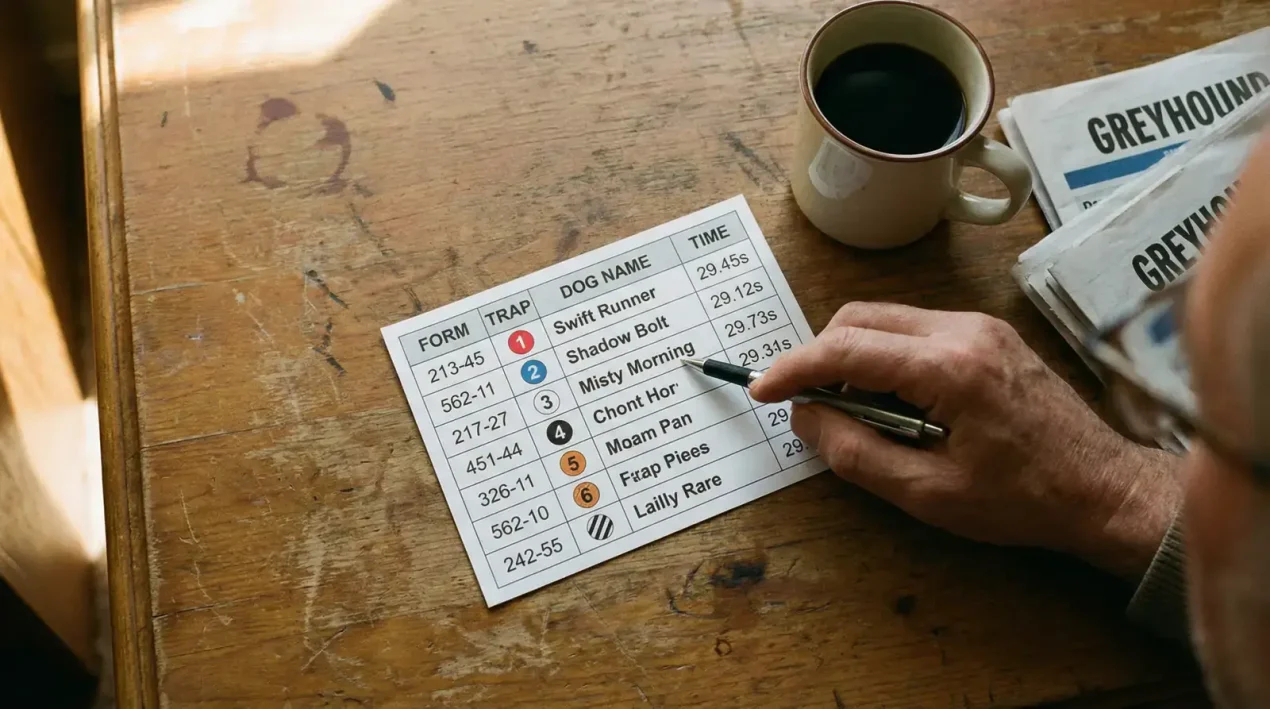
Contents
The Race Card Is a Cheat Sheet — If You Know How to Use It
Most bettors glance at the card. The profitable ones interrogate it. That single difference — the gap between a casual scan and a structured read — accounts for more lost money in greyhound racing than bad luck, poor trap draws, or dodgy going conditions combined.
A greyhound race card is one of the most information-dense documents in UK betting. In a few compressed lines, it tells you each dog’s recent finishing positions, their weight on the day, how fast they ran their sectionals, what grade they’re competing in, and who trained them. For a six-runner field, that’s a remarkable amount of data packed into something you can read on your phone while queuing for a coffee. The problem is that most people don’t read it at all — they look at it, register a couple of numbers, maybe recognise a trap colour, and back whatever feels right.
This guide is built for UK punters who want more from the race card than a hunch. We’ll break down every element — from the race header to the form figures, from sectional times to weight fluctuations — and explain not just what each piece of data means, but how it connects to everything else on the card. Greyhound form is not about memorising codes. It’s about recognising patterns, spotting anomalies, and building a picture of what’s likely to happen in the next thirty seconds of racing.
The race card gives you the raw material. Your job is to assemble it faster and more accurately than the market does. And in a betting medium where the fields are small, the turnaround between races is fast, and the markets are thinner than horse racing, that skill translates directly into an edge.
If you’re coming from horse racing, you’ll notice the format is simpler. If you’re coming from football betting, you’ll notice it’s far more precise. Either way, the race card is where profitable greyhound betting starts — and it’s worth learning properly.
Anatomy of a Greyhound Race Card
A standard UK greyhound race card follows a consistent layout across all GBGB-licensed tracks (GBGB Racing), which means once you learn to read one, you can read them all. The structure breaks into two distinct layers: the race header at the top, which sets the context for the entire event, and the runner details below it, which give you the individual data on each of the six dogs.
Understanding the relationship between these two layers matters more than memorising either one in isolation. A dog’s finishing time means nothing without knowing the distance and grade. A weight reading means nothing without knowing when the dog last raced. The card is designed to be read as a connected system, not a collection of isolated facts, and the bettors who treat it that way tend to outperform those who cherry-pick individual data points.
Let’s strip it back to the components.
Race Header: Track, Time, Distance, Grade
The header tells you the battlefield before you see the combatants. At the top of every race card, you’ll find the track name, the scheduled off-time, the race distance in metres, and the grade. These four pieces of information immediately frame how you should evaluate everything beneath them.
The track name matters because every venue has its own geometry — different bend tightness, different straight lengths, different surface characteristics. A 480-metre race at Romford is a fundamentally different proposition from a 480-metre race at Towcester. The distance tells you what type of race you’re dealing with: sprint (typically 250–300 metres), standard (450–500 metres), middle (600–700 metres), or staying (800 metres and above). Each category demands different physical attributes from the runners.
The grade is perhaps the most overlooked element. UK greyhound racing uses a grading system from A1 (highest) down to A9 or lower, depending on the track. Open races sit outside the graded structure entirely, attracting the strongest dogs in specific categories. The grade tells you the competitive level. A dog that’s won three of its last five races in A6 might be moving up to A4 — and that context changes everything about how you read its form figures. Without the grade, form is noise. With it, form starts telling a story. Learning to check the grade before anything else on the card is one of the simplest habits that separates informed bettors from the rest.
Runner Information: Name, Trainer, Weight, Colour
Behind every dog name is a datasheet of physical and competitive history. Each runner line on the card typically displays the trap number and colour, the dog’s name, the trainer’s name, the dog’s weight at the weigh-in, and the form figures. Some cards also include the dog’s best time over the course distance, its dam and sire, and its age.
The trap number (1 through 6) corresponds to a standard colour code used across all UK tracks: red, blue, white, black, orange, and black-and-white stripes (GBGB Rule 118). This isn’t decorative — it determines the dog’s starting position and, by extension, its likely first-bend path. Trap assignment in graded races follows a seeding system based on the dog’s run style (railer, middle, wide), while open races use a random draw, which can dramatically alter each runner’s chances.
The trainer name is worth noting because certain kennels have strong track-specific records. Over time, you’ll learn which trainers consistently produce well-prepared dogs for specific venues. Weight is listed in kilograms and represents the dog’s pre-race weigh-in figure — a data point that gains real significance when you start tracking changes between races, as we’ll cover later in this guide. But before weight, before trap draw, before anything else, there’s one piece of information on the runner line that demands the most careful reading: the form figures.
How to Read Greyhound Form Figures
Form figures are compressed performance data — six characters that can save or cost you money. In UK greyhound racing, form is displayed as a string of numbers and letters reading from left to right, with the most recent result on the right-hand side. Each character represents a single race start, and the string typically covers the last six runs. For a dog with the form line 3214-1, you’re looking at finishes of third, second, first, fourth, a hyphen (indicating a break or no race), and first in the most recent outing.
The numbers are straightforward: 1 means first, 2 means second, all the way through to 6 for last in a standard six-runner field. But the figures alone don’t tell you enough. A sequence of 1-1-1 looks impressive until you realise those wins came in A8 and the dog has just been promoted to A5. Equally, a line of 4-5-3 might look unremarkable, but if those runs came in A2 company and the dog is now dropping to A4, the picture changes dramatically. Form figures only gain meaning when read alongside grade, distance, and track context.
It’s also worth noting that a hyphen in the form string usually indicates a break between races — either a rest period, a trial, or a layoff due to injury. Dogs returning from a gap of two or more weeks should be assessed cautiously. Their fitness might be uncertain, and the hyphen is your cue to look deeper at the trial form or trainer comments before making any assumptions about their readiness.
What the Letters and Codes Mean
W, M, Bk, SAw — each abbreviation is a micro-story from a previous race. Beyond the numerical finishing positions, UK race cards use a set of standardised letter codes that describe incidents or run styles during the race. These are crucial for interpreting why a dog finished where it did, rather than simply accepting the number at face value.
The most common codes you’ll encounter include: W (wide), indicating the dog ran wide around the bends, typically losing ground; M (middle), meaning the dog raced in the middle of the pack rather than on the rail or wide; Bk (baulked), signifying the dog was impeded by another runner, which usually costs at least a length or two; SAw (slow away), indicating a poor start from the traps; Crd (crowded), where the dog was hemmed in or squeezed for room; and Ld (led), meaning the dog led the field at some point during the race. Less common but equally important are RIs (ran in straight), Chl (challenged), Blk (blocked), and Fell for a dog that went down during the race.
These codes transform a bare finishing position into context. A dog showing “4-Bk” ran fourth but was baulked — it might have finished second or third with a clear run. A dog showing “2-SAw” came second despite a slow start, which suggests it has strong finishing pace. Reading the letters alongside the numbers is where form analysis stops being passive and starts becoming predictive.
Spotting Patterns in Recent Form
Consistency beats brilliance when the form line stretches over five runs. The most useful skill in greyhound form reading isn’t identifying a single impressive result — it’s recognising sustained patterns that suggest reliability. A dog with form of 2-2-1-3-2-1 at the same track and grade is far more bankable than one showing 1-6-1-5-1-6, even though both dogs have the same number of wins. The second dog is clearly talented but erratic, and erratic dogs destroy betting banks.
When scanning form, look for trends rather than peaks. Is the dog improving or declining? A line of 5-4-3-2 shows clear upward movement. Is it performing consistently at a specific distance? Some dogs are track-and-distance specialists who produce mediocre results elsewhere. Is there a pattern of slow starts followed by strong finishes, suggesting the dog needs the first bend to find its stride? All of these trends are visible in a six-run form line if you know what to look for.
Pay particular attention to the most recent two or three runs. In greyhound racing, recency is king. Dogs can change fitness levels, gain or lose sharpness, and respond to grade changes within the space of a few weeks. A dog whose last three runs read 1-1-2 demands your attention regardless of what happened four, five, or six starts ago. Conversely, a dog that showed strong early form but has tailed off in its last three runs — say, 1-2-5-5-6 — is signalling something. Maybe the grade has caught up with it, maybe it’s carrying a niggle, or maybe the trainer has changed something. The form line tells you to investigate further before assuming the dog will bounce back.
Using Sectional Times and Split Data
A finishing time tells you who won. A sectional time tells you how — and whether they’ll do it again. While finishing times are the headline figures on any race card, they’re also the crudest measure of a dog’s ability. Two dogs can both clock 29.50 seconds over 480 metres but do it in completely different ways — one by leading from trap to line, the other by coming from last to first around the final bend. Sectional times break the race into segments and reveal which dogs have genuine early pace, which are strong finishers, and which are flattered by circumstances.
In UK greyhound racing, sectional times typically split the race into two or three phases. The most commonly reported is the “run to the first bend” split, sometimes called the early sectional or calculated sectional time. This is the critical data point. Early pace is the single biggest predictor of success in greyhound racing because the first bend is where most trouble happens. A dog that reaches the bend in front avoids crowding, baulking, and the accordion effect that punishes dogs caught in the pack. The early sectional tells you which dogs are most likely to avoid that chaos.
Comparing a dog’s sectional times across multiple runs at the same track and distance gives you a truer picture of its ability than raw finishing times. A dog that consistently posts fast early sectionals — even when its finishing times vary — is a dog with a genuine physical advantage at the start. Conversely, a dog with inconsistent sectionals is one whose performance depends heavily on how the race unfolds around it, making it a riskier proposition for your money.
One critical nuance: sectional times are only comparable within the same track and distance. A 4.80-second first-bend split at Romford is a different animal from 4.80 at Nottingham because the trap-to-bend distances differ. Never compare sectionals across venues — you’ll be comparing measurements taken with different rulers.
When race cards display calculated sectional times alongside finishing times, you have a powerful tool. Look for dogs whose early sectionals are improving while finishing times stay steady — these dogs are trapping faster and should be hitting the first bend in better positions. That improvement often precedes a run of strong results, and the market doesn’t always price it in quickly.
Weight Changes and What They Signal
Weight is the one variable you can see before the traps open. Every dog is weighed before racing, and that figure is printed on the card alongside the dog’s previous race weight, allowing you to spot fluctuations immediately. In a sport where margins are measured in fractions of a second, weight changes of even half a kilogram can be the difference between a dog leading at the first bend and a dog fading on the run-in.
The general rule among experienced greyhound punters is that a weight change of up to 0.5 kilograms in either direction between races is perfectly normal and nothing to worry about. Dogs fluctuate naturally depending on when they last ate, their hydration levels, and the intensity of recent training. It’s the changes beyond that threshold that warrant attention. A gain of more than one kilogram between races — particularly over a short period — can indicate that the dog has been inactive, overfed, or is carrying an issue that’s limited its exercise. A loss of more than one kilogram might suggest stress, illness, or being over-raced.
Context matters here. A dog returning from a layoff of three or four weeks might reasonably carry an extra kilo. That’s expected and doesn’t necessarily signal a problem. What you’re looking for are unexpected changes — a dog that’s been racing weekly at 32.5 kilograms suddenly showing up at 33.8 when there’s no obvious reason. That kind of swing should make you look harder at the dog’s recent form and trainer pattern before committing your money.
There’s a subtler dimension to weight analysis that most race card readers miss entirely. It’s not just about whether a dog is lighter or heavier — it’s about what that weight change means in the context of the dog’s racing style. A front-runner that gains a kilogram may still lead, but it’s more likely to tire on the run-in. A strong finisher that’s slightly lighter than usual might close even faster in the final straight. By cross-referencing weight data with sectional times from previous races, you can start to build a predictive picture of how a dog’s physical condition will translate into on-track performance.
Track the weight over four or five races rather than just comparing the current figure to the previous one. A gradual upward trend from 30.0 to 30.8 across six starts tells a different story than a dog that’s bounced between 29.5 and 31.0. The former suggests the dog is steadily bulking up — possibly ageing or slowing down — while the latter suggests inconsistency in preparation that might reflect wider issues at the kennel level.
Weight data on its own won’t make you profitable. But combined with form figures, sectional times, and grade context, it adds a layer of physical information that many punters overlook completely. And in a market as thin as greyhound betting, overlooked information is exactly where edges live.
Understanding the Race Grade and Class Level
A dog dropping from A3 to A5 isn’t declining — it’s being given an opportunity. The UK grading system is the structural framework that governs which dogs race against each other, and understanding it is essential for interpreting form correctly. Without grade context, you’re reading data in a vacuum. With it, every form figure, every finishing time, and every sectional split gains a layer of meaning.
In the GBGB system, graded races run from A1 at the top down to A9 or A10 at smaller tracks, with each level representing a band of ability. Dogs are promoted (graded up) after winning or performing consistently well, and demoted (graded down) after a string of poor results. The specific rules vary slightly between tracks, but the principle is universal: the grading system attempts to match dogs of similar ability for competitive racing.
For bettors, the grading system creates two types of opportunity. The first is the class dropper — a dog that has been performing in a higher grade and is now moved down to easier competition. This dog’s recent form might look modest: fourth, fifth, third. But those finishes came against better opponents. Drop it into a lower grade and it’s suddenly one of the strongest runners in the field. Class drops are among the most reliable angles in greyhound betting because the market often prices these dogs based on their recent finishing positions without fully accounting for the quality of opposition they faced.
The second opportunity is the opposite: the class riser that’s overpriced. A dog promoted from A6 to A4 on the back of a couple of wins will often start as favourite in its new grade. But the jump in quality can be significant. If the dog’s wins were narrow, its sectional times mediocre, and the fields it beat were weak even for A6 standard, the promotion might expose its limitations. The market sees “two recent wins” and backs accordingly, but the form card tells you the full story if you read it properly.
Open races deserve separate attention. These sit outside the standard grading structure and are designed for specific categories — puppy opens, veteran opens, sprint opens, stayers opens, or invitation events. The grading rules don’t apply, and the random trap draw means that seeding goes out the window. Open races attract stronger, more unpredictable fields, and the lack of seeded trap positions adds a significant variable. For bettors, this means that form analysis in open races requires even more emphasis on run style and trap draw luck, since a fast railer drawn in trap 6 faces a fundamentally different challenge than one drawn in trap 1.
The grade listed in the race header isn’t just administrative detail — it’s the lens through which every other piece of form data should be interpreted. Build the habit of checking it first, before you look at anything else on the card.
Form Doesn’t Predict — It Narrows the Field
No form figure guarantees anything, but ignoring form guarantees you’re guessing. That distinction matters. Greyhound racing is a sport of probabilities, not certainties, and the race card is a probability tool. It doesn’t tell you which dog will win — it tells you which dogs have the strongest evidence for running well, and which are likely to underperform relative to their price.
The punters who consistently profit from greyhound betting share a common approach: they use every data point on the card — form figures, sectional times, weight, grade, trap draw, trainer — as a filter. Each piece of information eliminates one uncertainty and narrows the field of plausible outcomes. By the time they’ve worked through the full card, they haven’t predicted the winner, but they’ve identified which dogs represent value at the prices offered and which ones the market has priced incorrectly.
That’s a fundamentally different mindset from the typical punter who looks at the card, picks the dog with the most 1s in its form line, and backs it at whatever odds are showing. The card rewards thorough reading. It punishes lazy reading. And once you’ve learned to read it properly, you’ll never look at a greyhound race card the same way again.
Start with one track. Learn its grades, its distances, its trap biases. Read every card for a week without betting. You’ll be surprised how quickly the compressed data starts to speak clearly — and how obvious the edges become once you stop glancing and start reading.
Get more form guides at greyhoundbettingtipsuk.
Also read our sectional times guide.
