
UK Greyhound Tracks: Complete Guide to Every GBGB Venue
 Available in US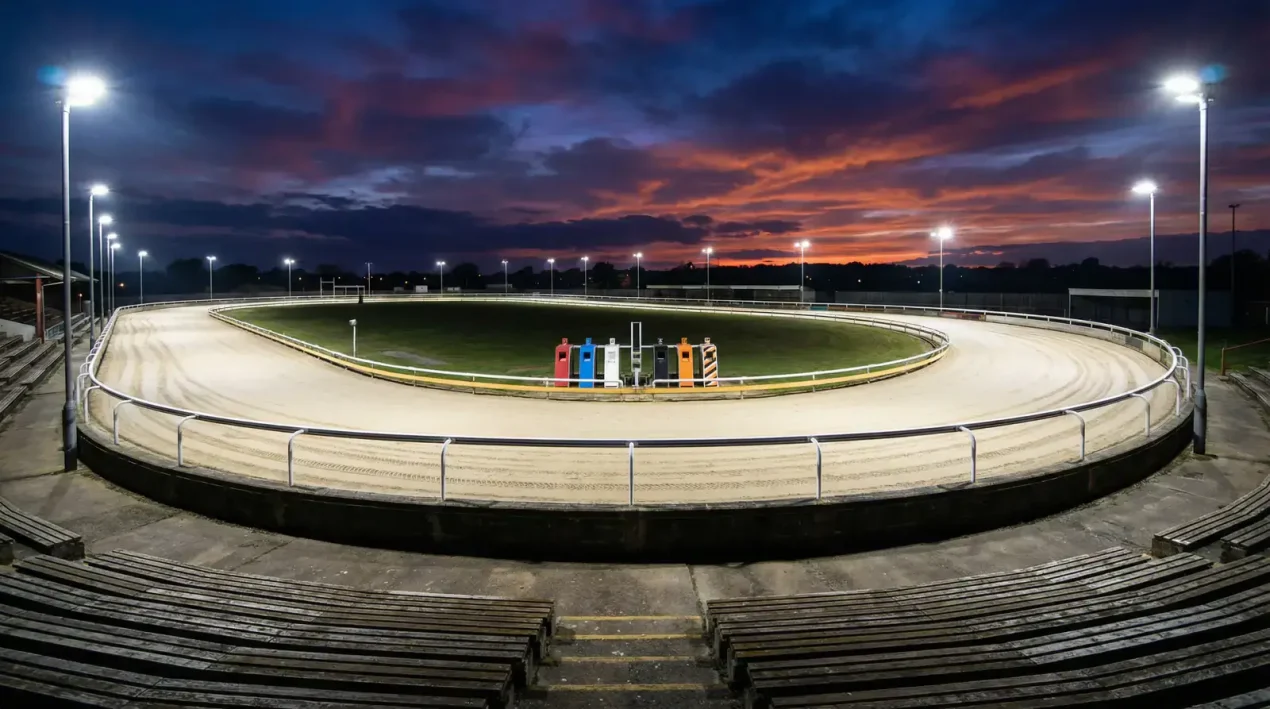
Contents
Eighteen Tracks, Eighteen Different Puzzles
Every UK greyhound track has a personality — learn it, and you own an edge the tourist punters don’t. The GBGB currently licenses eighteen stadia across England and Wales (GBGB Racecourses), each with its own circuit geometry, distance menu, surface characteristics, and racing calendar. For the casual bettor, a greyhound race is a greyhound race. For anyone serious about finding an edge, the track is as important as the dogs running on it.
Track knowledge is the most undervalued weapon in greyhound betting. The same dog can be a confident selection at one venue and a pass at another, purely because of how the bends tighten, how the surface drains, or where the pace bias sits on a given evening. Trap one at Romford is not trap one at Towcester. A 480-metre race on a tight inner-city circuit plays nothing like a 480-metre race on a wide, galloping track. These differences are measurable, consistent, and — crucially — underpriced by the market, which tends to treat all tracks as interchangeable.
This guide profiles the major tracks from a betting perspective, breaks down the distance categories, explains how bias patterns form and shift, and covers the essential distinction between daytime BAGS meetings and evening open racing. The goal is not to provide an encyclopaedia of every venue. It’s to demonstrate why track specialisation works and give you the framework to apply it to whichever track you choose.
Major Track Profiles and Betting Angles
We break down the key tracks by distance, bias, and what the smart money watches. The profiles below aren’t comprehensive venue guides — they’re betting-focused snapshots designed to illustrate how different circuits create different selection criteria. Each track rewards a particular type of dog, and understanding that relationship is where track knowledge converts into profit. While there are eighteen licensed stadia in the current GBGB network — from Newcastle in the north-east to Hove on the south coast — we’ll focus on four venues that represent distinctly different betting environments.
Romford: The Sprint Capital
Romford’s tight circuit rewards early pace and inside runners. Situated in east London, Romford is one of the busiest tracks in the country and a venue that consistently favours a specific type of dog. The circumference is compact, the bends are tight, and the run to the first turn is short. All of this means that the dog who leads into the first bend usually wins. Late closers struggle here because there’s simply not enough straight to overhaul a front-runner, and the tight bends make passing on the outside extremely difficult.
The standard distance at Romford is 400 metres, which is shorter than most tracks and plays as a sprint-to-middle affair. The track also hosts sprint races at even shorter distances and occasionally runs longer events, but the 400-metre card is the core product. Trap one carries a statistical advantage because the inside line into the first bend is the shortest path, and a fast-breaking railer drawn there can build an unassailable lead within the first few seconds. Traps five and six are at a measurable disadvantage, particularly for dogs that don’t possess genuine early pace.
For bettors, Romford is a track where early sectional times are more predictive than finishing times, and where trap draw analysis carries disproportionate weight. If you specialise here, your form assessment should always start with the question: who reaches the first bend in front? The answer to that question resolves more races at Romford than any other single factor. It’s also a venue where lay betting can be particularly effective — favourites drawn in traps five or six that lack early pace are frequently overbet by the market, offering value on the lay side.
Towcester: Where Stamina Sorts the Field
Towcester’s long straights and galloping track expose one-paced dogs. Located inside the Towcester horse racing course in Northamptonshire, this is the most unusual greyhound venue in Britain. The circuit has wide, sweeping bends and long straight sections, with a notable uphill gradient on the back straight that tests fitness in a way no other UK track can match. The standard distances here include 270, 480, and 500 metres, with stayers’ events run over 712 metres.
As the home of the English Greyhound Derby — run over 500 metres (Towcester Racecourse — Derby) — Towcester attracts the highest-quality fields in the calendar during competition season. But its physical characteristics make it a different selection puzzle. The wide bends reduce the advantage of inside trap draws, meaning that wide runners and middle-seed dogs have a fairer chance than at tighter tracks. The uphill section rewards dogs with genuine stamina and punishes those that rely solely on early speed. When assessing form at Towcester, prioritise dogs with strong run-home sectionals and consistent finishing effort over pure early pace. A dog that leads at the first bend but fades on the hill is a common sight here — and a common source of overbet favourites.
Monmore Green: The All-Rounder
Monmore’s mixed card draws a balanced programme. Based in Wolverhampton, Monmore Green is one of the most active tracks in the GBGB calendar, hosting regular meetings throughout the week with a well-stocked graded programme and a strong open-race schedule. The circuit is medium-sized with fair bends, and the standard distances include 264, 480, and 630 metres, giving bettors a range of sprint, middle, and staying events to work with on most cards. Major competitions like the Ladbrokes Winter Derby and Ladbrokes Puppy Derby give the venue genuine prestige in the racing calendar (GBGB Open Race Calendar 2025).
What makes Monmore interesting from a betting perspective is its relative balance. It doesn’t favour inside runners as aggressively as Romford, nor does it neutralise trap position like Towcester. The bias is moderate and tends to shift with card composition and going conditions. On dry evenings, the inside tends to hold a slight edge at sprint distances. When the track is wetter, the bias flattens and wide runners gain more of a foothold. Tracking these shifts week by week gives you a granular advantage that most casual bettors won’t bother to develop.
Form analysis at Monmore requires a more rounded approach — sectional times, weight trends, and grade context all carry genuine weight, and no single factor dominates the way early speed dominates at sprint-biased venues. For punters who enjoy thorough, multi-factor form reading, Monmore is an ideal specialisation track. The frequency of racing here also means you’ll accumulate data quickly, allowing you to refine your approach over a meaningful sample size within a few weeks.
Brighton and Hove: Evening Class
Hove’s evening cards attract quality open-race fields. Brighton and Hove Greyhound Stadium — known universally as Hove — is located on the Sussex coast and has long been regarded as one of the classier venues in UK greyhound racing. The track has a circumference of around 455 metres with standard distances of 285, 515, and 695 metres, plus a 500-metre trip introduced in 2019. The venue hosts prestigious events including the Coral Olympic and the Coral Regency. The circuit is well maintained and tends to produce fair racing with moderate trap bias. (Source: GBGB Racecourses)
Hove’s reputation is built on its evening and weekend racing programmes, which regularly feature strong open-race cards. These events draw competitive fields from top kennels, and the standard of dog is typically a notch above the average weekday BAGS card. For bettors, this means that Hove evening races present a different challenge: the form is harder to separate, the margins are thinner, and the market is more efficient because better dogs attract more informed money.
The flip side is that when you do find an edge at Hove — a class dropper overlooked in a strong field, a dog with improving sectionals that the market hasn’t caught up to — the value tends to be more durable, because the higher-quality fields produce more reliable outcomes. The 500-metre standard distance also makes Hove a good barometer for comparing dogs across venues, since it’s the same trip as the Derby distance at Towcester. If a dog posts a competitive time over 500 metres at Hove, that form has genuine currency elsewhere.
Understanding Distance Categories at UK Tracks
Sprint, standard, middle, stayer — the distance determines the selection criteria. UK greyhound racing categorises distances into four broad bands, and each one demands a fundamentally different type of dog. The categories aren’t just labels — they’re shorthand for the physical and tactical attributes that determine success, and treating them interchangeably is one of the most common analytical errors in greyhound betting.
Sprint races cover distances from roughly 250 to 305 metres. These are pure speed tests where the race is often decided within the first few seconds. Trap draw and early pace are overwhelmingly dominant factors at sprint distances. The race is too short for a slow starter to recover, and the lack of a second bend at many tracks means that positional advantages from the first turn carry all the way to the line. When betting on sprints, your form analysis should weight trap position and early sectional times above almost everything else.
Standard distances — the 450 to 500-metre band — are the bread and butter of UK graded racing and the most commonly run category at every track. These races typically involve two full bends and a finishing straight, which introduces tactical variety. Early pace still matters, but strong finishers have enough track to overhaul front-runners who tire, and middle-seed dogs have more opportunities to find racing room. Form reading at standard distances is the most balanced exercise in greyhound betting: trap, pace, stamina, weight, and class all carry meaningful weight.
Middle-distance events (roughly 600 to 700 metres) and staying races (800 metres and above) shift the emphasis toward stamina and sustained pace. Dogs that rely on pure early speed tend to fade at these distances, while grinders with consistent stride length and strong finishing effort come into their own. Weight becomes a more significant factor at longer distances because heavier dogs expend more energy over additional metres. Track knowledge matters even more in staying races because the configuration of the second and third bends — present only at longer distances — can create trap biases that don’t exist in standard-distance events at the same venue.
The practical takeaway is that your selection method should adapt to the distance category before you even look at the runners. At sprints, build your shortlist around trap and early pace. At standard distances, use a balanced approach. At middle and staying trips, weight the run-home sectional, stamina pedigree, and fitness indicators more heavily. Applying the same criteria across all distance categories is a structural error that guarantees inconsistency in your results.
Track Bias Patterns and How to Exploit Them
Track bias is not static — it shifts with maintenance, weather and card composition. Every greyhound track has some degree of bias toward particular trap positions or run styles, but treating that bias as permanent is a mistake that costs punters money. Bias patterns are influenced by the track surface condition, which changes with weather and maintenance schedules; the hare type and running rail configuration; the specific distance being raced; and even the composition of the card itself — a meeting loaded with seeded railers in the early traps will produce different outcomes from one with more balanced seeding.
The most common form of bias is inside-trap favouritism. Across UK tracks as a whole, trap one wins more often than trap six. This is partly geometrical — the inside line into the first bend is the shortest route — and partly a consequence of the seeding system, which places known railers in traps one and two. But the magnitude of this advantage varies enormously between venues. At tight, sprint-oriented tracks like Romford, the inside advantage is substantial and persistent. At wide, galloping circuits like Towcester, it’s much weaker. And at some tracks, specific outside traps can actually outperform the inside under certain conditions, particularly at longer distances where the race dynamic is more complex.
To exploit track bias effectively, you need to track results over a meaningful sample. A week’s worth of data at a single venue — typically sixty to eighty races — will start to reveal patterns. Two to four weeks gives you a robust picture. Record the winning trap for every race at your chosen track, broken down by distance category, and look for persistent deviations from what you’d expect if all traps won equally (roughly 16.7 percent each in a six-runner field). If trap one is winning 25 percent of sprint races at your track while trap six is winning 8 percent, that’s not noise — that’s actionable data.
The practical application is straightforward. When your form analysis produces two or three closely matched dogs, use trap bias as the tiebreaker. A dog drawn in a statistically favourable position at that specific track and distance gets the edge over one drawn in a weak position. This isn’t about blindly backing trap one in every race — it’s about incorporating venue-specific positional data into a broader assessment. Bias data should narrow your decisions, not replace your form reading.
Watch for bias shifts. After heavy rain, some tracks develop a stronger inside bias because the rail line drains faster and provides firmer footing. After resurfacing or maintenance work, established patterns can reset entirely. If your bias data suddenly stops correlating with results, the track conditions have probably changed, and you need to update your data. The punters who treat track bias as a living dataset rather than a fixed table maintain a persistent advantage over those who rely on outdated statistics.
BAGS Meetings vs Evening Open Racing
BAGS and open racing are different animals — treat your approach accordingly. The Bookmakers Afternoon Greyhound Service — universally known as BAGS — provides the daytime greyhound racing product that fills betting shop screens and bookmaker websites from late morning through the afternoon (SIS — About Greyhound Racing). These meetings run at tracks across the country on a fixed schedule and form the backbone of the daily betting volume. Evening and weekend racing, by contrast, tends to feature the stronger cards — graded events with better-quality fields, open races that attract the top dogs from major kennels, and competition rounds for major tournaments like the Greyhound Derby and St Leger.
The distinction matters for betting because the competitive dynamics differ significantly. BAGS meetings typically feature lower-grade racing with smaller fields drawn from the local kennel population. The standard of dog is generally lower, the margins between runners are often wider, and the form tends to be more predictable within its tier. For bettors, this means that thorough form analysis on BAGS cards can produce a higher strike rate than at evening meetings, because the weaker fields contain more clearly identifiable front-runners and more obviously outclassed dogs.
Evening open racing is the opposite. Fields are stronger, margins between runners are tighter, and the market is more efficient because the bigger events attract more informed money. The form is harder to read because dogs competing in open races are operating at or near their peak ability, making separation difficult. But the payoff when you do find an edge is potentially larger — longer-priced winners, more volatile forecasts, and less predictable outcomes create opportunities for punters who have done deeper work than the crowd.
A pragmatic approach is to use BAGS meetings as your bread-and-butter betting medium — steady, data-rich, and rewarding for disciplined form reading — while treating evening open racing as a selective, higher-risk opportunity. Don’t approach both with the same staking or the same expectation. BAGS is where you grind out consistent small edges. Evening opens are where you deploy specialist knowledge on specific events and accept higher variance for the possibility of larger returns. Some punters focus exclusively on one or the other, and there’s nothing wrong with that — the important thing is to recognise that the two products demand different analytical approaches and different bankroll management.
Pick a Track. Learn It. Own It.
Generalist knowledge builds context; specialist knowledge builds profit. The single most actionable piece of advice in this guide is also the simplest: choose one track and learn it deeply. Learn its distances, its trap biases at each distance, its grading patterns, which kennels send their best dogs there, how the surface behaves in different weather, and which race types produce the most predictable outcomes. Within a month of focused study, you’ll understand that venue better than 90 percent of the people betting on it.
Specialisation works in greyhound betting for the same reason it works in any competitive domain — depth beats breadth. The punter who knows every quirk of one track will consistently outperform the one who casually follows six tracks without mastering any of them. The data compounds. After three months at a single venue, you’ll start recognising dogs by name, noticing kennel patterns that others miss, and instinctively adjusting your assessments based on trap draws that you’ve already evaluated dozens of times.
Start local if possible — a track you can visit, where you can watch races live and observe how the running rail affects different traps, how dogs behave on the bends, and how the surface changes through an evening card. If you can’t attend in person, pick a track with regular BAGS coverage and build your dataset from the daily cards. The track doesn’t have to be a glamorous venue. Some of the most exploitable edges in UK greyhound betting exist at smaller, less fashionable tracks where market attention is thinnest and pricing is least efficient.
Once you’ve built your knowledge of one venue, expanding to a second becomes far easier — not because the second track is the same, but because you’ve already built the analytical framework. You know what to look for, which data points matter, and how to identify bias patterns. That process is transferable. The specific knowledge isn’t. And that’s exactly why the punters who commit to learning one track first tend to outperform the ones who try to follow everything from the start.
Find more track guides at greyhoundbettingtipsuk.
Also read our greyhound track bias guide.
