
Greyhound Early Speed Ratings
Best Greyhound Betting Sites – Bet on Greyhounds in 2026
Loading...
Contents
Early Pace as the Dominant Factor in Greyhound Racing
If you could know only one thing about each dog in a greyhound race, the most useful piece of information would be its early speed. Not its overall time, not its finishing position last week, not its weight or its trainer — its speed from trap to first bend. That single data point predicts race outcomes more reliably than any other variable in the sport, and understanding why gives you a framework for evaluating every race you bet on.
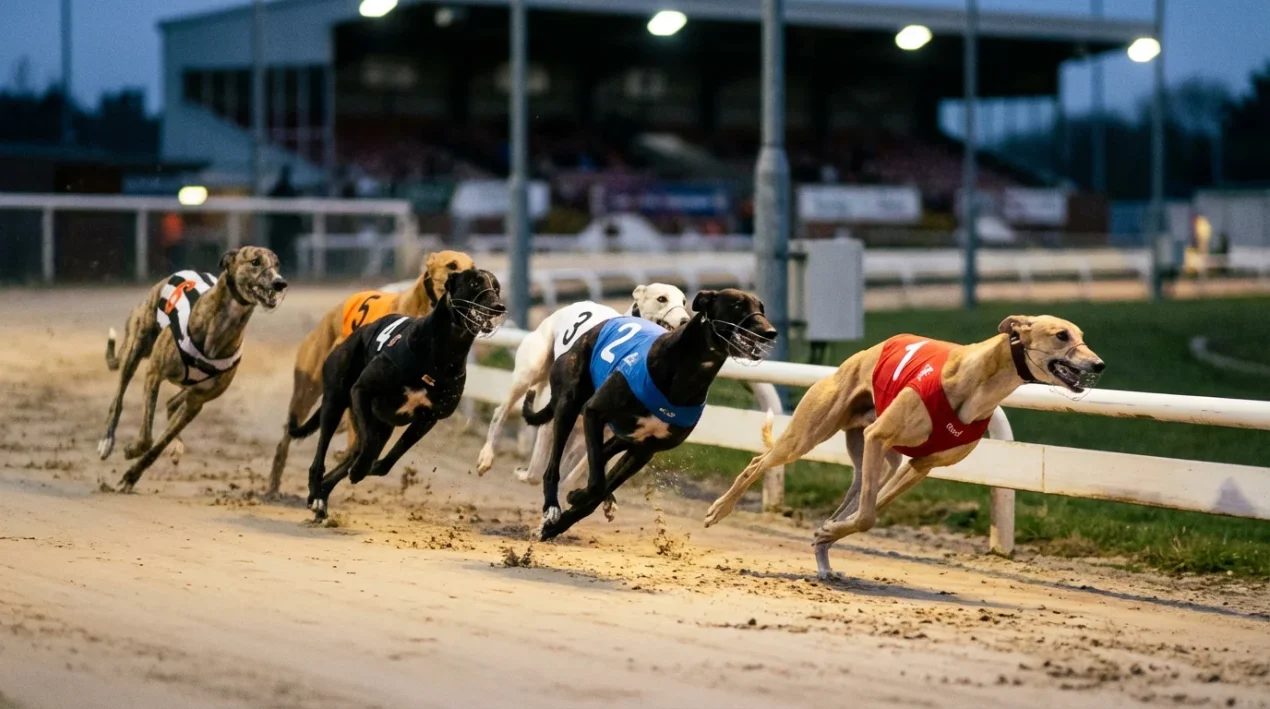
Greyhound racing is fundamentally shaped by the first bend. Six dogs converge from their traps into a left-hand turn that narrows the available running room dramatically. The dog that arrives first gets the cleanest path. The others must navigate traffic, accept wider running lines, or check their stride to avoid collisions. Every disadvantage that follows from a poor first bend — extra distance covered, momentum lost, position surrendered — is a consequence of arriving late. Early speed is not just a nice attribute. It is the primary determinant of how a race unfolds.
Why First-Bend Position Predicts the Finish
Statistical analysis of UK greyhound results consistently shows a correlation between first-bend position and finishing position. Dogs that lead at the first bend win at a rate substantially above the 16.7% base expectation. The exact figure varies by track and distance, but across the sport as a whole, the first-bend leader wins roughly 35-40% of races under 500 metres. By comparison, dogs that are last at the first bend win less than 8% of the time.
The advantage compounds through the race. The leader at the first bend typically rails — hugs the inside line — through the subsequent bends, covering the shortest possible distance. Dogs behind and outside it run further, expend more energy navigating traffic, and need to find clear running room before they can challenge. Even a marginal early-speed advantage — half a length at the first bend — translates into a positional advantage that persists and often widens through the remainder of the race.
This effect is strongest at tight tracks with short runs to the first bend. At Romford, Crayford, and similar compact circuits, the first bend arrives within a few seconds of the traps opening, giving dogs almost no time to recover a slow start. At larger tracks with longer runs, the effect still exists but is diluted — a slow starter has more ground to make up before the field compresses into the first turn.
The implication for bettors is clear: in any race under 500 metres, your default question should be “which dog gets to the first bend first?” If you can answer that with reasonable confidence based on early-speed data, you have the most powerful single piece of information available in greyhound race assessment.
How Early Speed Is Measured from Sectionals
Early speed is quantified through first-bend sectional times — the time taken from trap opening to the first bend. These splits are recorded at some UK tracks by electronic timing equipment and published through data services and the Racing Post. Where electronic sectionals aren’t available, race comments provide qualitative evidence: “led first bend,” “prominent early,” “crowded first bend,” or “slow away.”
A raw first-bend time is only meaningful relative to the track and distance. A split of 4.80 seconds at one track means something different from 4.80 at another, because the distance from traps to first bend varies. Within a single track and distance, however, the data is directly comparable. If three dogs in tonight’s A4 race at Monmore 480 metres have first-bend sectionals from recent runs at the same venue, you can rank them by pace with confidence.
When building early-speed ratings, account for trap draw. A dog that records a 4.85 split from trap 6 has shown more raw pace than one recording 4.85 from trap 1, because the outside dog had further to travel. Similarly, a dog with a fast split from an inside trap may owe some of its advantage to the draw rather than to pure pace. The most informative data points are fast sectionals from middle or outside draws — these indicate genuine early speed that isn’t position-dependent.
Race conditions also affect sectional comparisons. Wet surfaces slow early pace, so a 4.90 split on a rain-affected track may represent the same ability as a 4.80 on a dry surface. If you’re comparing sectionals across different race dates, check whether conditions were similar. Ideally, compare like with like — same track, same distance, similar conditions — to produce the cleanest assessment.
Using Pace Data to Rank Contenders
A practical early-speed ranking system for a single race involves three steps. First, gather the most recent first-bend sectional for each dog at tonight’s track and distance. Where sectionals aren’t available, use race comments to classify each dog as fast, average or slow to the first bend. Second, adjust for trap draw — upgrade dogs drawn inside if their pace is at least average, and downgrade dogs drawn outside unless their sectionals are clearly fastest. Third, cross-reference with the overall form to identify whether the pace leader is also the most talented runner in the field or merely the fastest to an early position that it can’t sustain.
The third step matters because early speed alone doesn’t guarantee victory. A dog that leads to the first bend but lacks stamina will be caught in the closing stages by a stronger finisher. The ideal selection is one that combines the fastest early pace with solid overall form — the dog that leads early and sustains its effort to the line. When early speed and overall form point to the same dog, you have a high-confidence selection. When they point to different dogs, the race is more open and the bet is less certain.
One common mistake is overweighting early speed in staying races. Over 640 metres and above, the race involves multiple bends and a longer straight, which gives closers more opportunity to make up ground. Early-speed leaders still hold an advantage, but it’s smaller than in sprints, and stamina becomes a co-equal factor. Adjust your pace weighting according to the distance: dominant in sprints, important in middle distances, one factor among several in stays.
Another useful application of early-speed data is in identifying false favourites. A dog may be favourite based on recent wins and overall times, but if its early-speed ratings show it relies on unchallenged leads, any race where another dog matches or exceeds its pace threatens to disrupt the pattern. Two front-runners in the same race often compromise each other — burning energy in the early stages and leaving both vulnerable to a closer. Recognising this dynamic from pace data, rather than discovering it when the race unfolds, is the difference between opposing a false favourite at value and backing it at a short price that doesn’t reflect the risk.
Speed at the Bend, Money at the Post
Early speed is not the whole story, but it is the opening chapter of every greyhound race, and the dog that writes it best starts with an advantage that the rest of the field must overcome. Measuring that speed, understanding how it interacts with draw and distance, and combining it with broader form analysis produces a selection framework that outperforms any method based solely on finishing positions or overall times.
The data is available. The calculation is simple. The edge comes from doing the work that most punters — even most regular greyhound bettors — don’t bother to do. First-bend pace is hiding in plain sight on the race card. Use it.