
Greyhound Grading System UK
Best Greyhound Betting Sites – Bet on Greyhounds in 2026
Loading...
Contents
Why Grades Exist in UK Greyhound Racing
Greyhound grading exists for the same reason weight classes exist in boxing: to ensure competitive races between animals of roughly comparable ability. Without a grading framework, the fastest dogs would win everything, the slowest would never compete meaningfully, and the betting product would suffer from predictable, uncompetitive fields. The system solves this by categorising dogs into bands and matching them against similarly rated rivals.
For bettors, the grading system is more than administrative scaffolding — it’s a source of information and, occasionally, of value. Understanding how grades work, why dogs move between them, and what happens at the boundaries between classes gives you context that many recreational punters ignore entirely. A form figure means one thing in isolation. In the context of the grade where it was achieved, it can mean something quite different.
A1 Through A9, Plus OR and OP Classifications
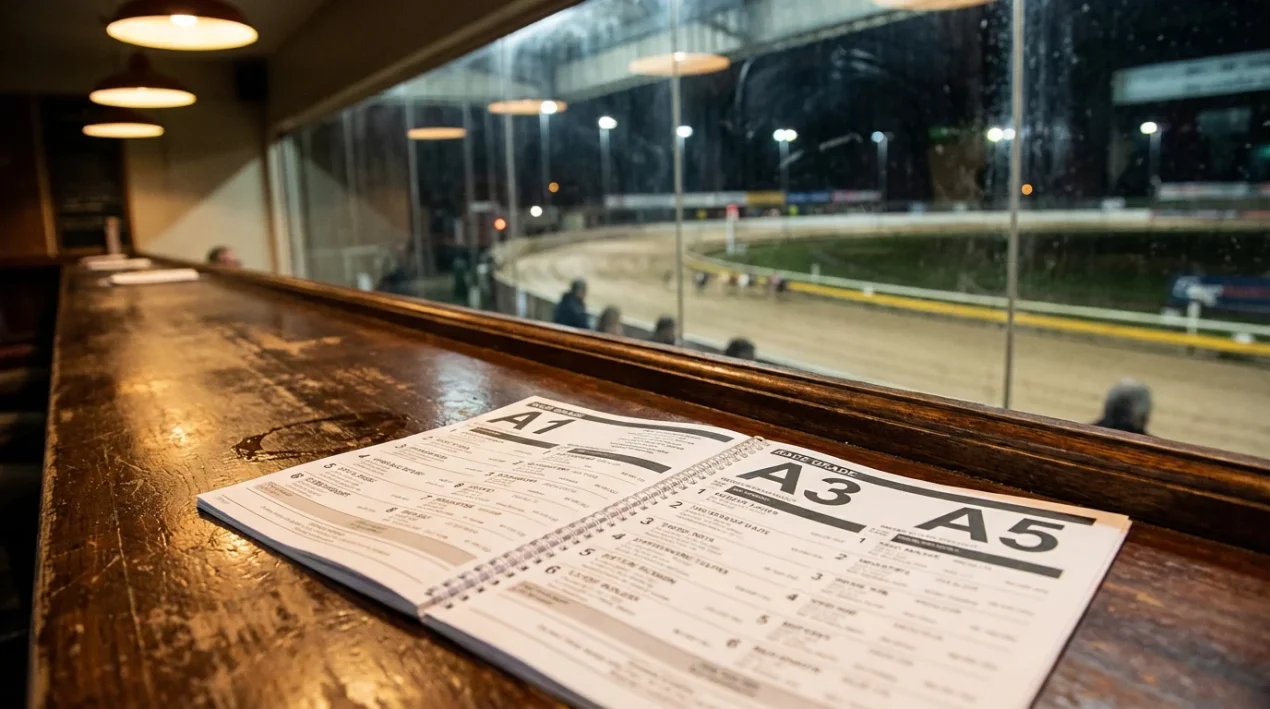
The UK grading system for GBGB-licensed tracks runs from A1 at the top to A9 at the bottom. A1 races contain the best dogs racing at a particular track, while A9 races feature the lowest-rated runners. Not every track uses all nine grades — the range depends on the quality and depth of the track’s greyhound population. A major track like Romford or Nottingham may run races from A1 through A7, while a smaller venue may concentrate around A4 to A8.
Above the standard grading tiers sit open races, designated OR. These are races without grade restrictions, designed for the highest-calibre dogs and often carrying larger prize pools. Open races at major tracks attract the strongest fields in the country and represent the pinnacle of regular competition. OP races — open to nominated entries — serve a similar function for specific events or invitational contests.
Within the lettered grades, races are further categorised by distance. A dog graded A3 at 480 metres is not necessarily A3 at 265 metres or 640 metres. Greyhounds may hold different grades at different distances depending on their performance over those trips. A sprinter that dominates over 265 metres might be a mid-grade performer at 480, and the grading system reflects that specialisation. This is important because a dog dropping in grade at one distance is a meaningful event — it signals a move to easier competition over that specific trip, not just in general.
Handicap races, designated by an H prefix, use a different format. Dogs of varying ability are drawn together but start at staggered positions or carry time penalties to equalise their chances. Handicap grading follows its own structure and won’t be confused with flat grading, but bettors should be aware that an H4 race and an A4 race don’t necessarily contain dogs of the same calibre.
Some tracks also run sprint, middle-distance and staying categories separately, each with its own grade ladder. A versatile dog might race at A2 over 480 metres and A4 over 640 metres at the same track, reflecting the reality that ability is distance-dependent. Knowing which grade applies to which distance for a particular dog is essential before interpreting its form.
How Dogs Get Promoted or Relegated
Grade movements are governed by results. The general principle is straightforward: win a race, move up; finish poorly, move down. In practice, the system has more nuance than that simple rule suggests.
A dog that wins an A4 race is typically promoted to A3 for its next run over the same distance at that track. The promotion is automatic in most circumstances and reflects the logic that a winner has demonstrated superiority over its current grade and should face tougher opposition. Some tracks apply this strictly — one win means one grade rise — while others may consider the margin of victory or the quality of the race before adjusting.
Demotion is less mechanical. A dog may need to finish out of the places in several consecutive races before being dropped a grade. The racing manager has discretion here, and factors like the quality of opposition faced, whether the dog suffered bad luck in running, and its overall ability level relative to the grade all play into the decision. A talented A3 dog that finishes fourth twice after being hampered at the first bend may not be immediately dropped to A4, whereas one that finishes fifth or sixth in untroubled running probably will be.
This asymmetry — quick promotion after a win, slower demotion after losses — creates a specific pattern. Dogs often get promoted into a grade where they’re not quite competitive, run a few modest races, and then get dropped back to their comfort level. The cycle is predictable once you recognise it, and it’s visible in form strings that show a win followed by a string of mid-field finishes followed by another win after the demotion. Understanding where a dog sits in this cycle is one of the most reliable ways to find value.
Exploiting Class Drops and Grade Boundaries
The most productive betting angle the grading system offers is the class drop. When a dog that has been competing at A3 is dropped back to A4, it’s returning to a level where it previously demonstrated winning form — often against weaker rivals than those it faced in the higher grade. Its recent form string might show 3-4-5-4 at A3, which looks poor until you realise every one of those runs was against dogs a class above its current competition. The 3-4-5-4 A3 dog running in tonight’s A4 race may well be the most talented animal in the field, despite having the worst recent form figures.
Markets often undervalue class droppers because algorithms and casual punters weigh recent finishing positions heavily without adjusting for grade. A dog returning 4-5-4 looks like a mid-field runner. The grade context tells a different story. If the drop is accompanied by a favourable trap draw and the dog’s earlier A4 form was strong, the odds available can represent genuine value.
Grade boundaries also create opportunities in the other direction, but as cautionary signals rather than betting triggers. A dog just promoted from A5 to A4 faces an immediate step up in opposition quality. Its recent form — probably including the win that triggered promotion — looks excellent, and the market often prices it accordingly, making it a short-priced favourite in its first A4 race. But the jump in class means untested competition, and short-priced dogs failing on first-time-at-grade runs is one of the most common losing scenarios in greyhound betting. Opposing these dogs, rather than backing them, is often the sharper play.
Look also for dogs that have been “yo-yoing” between two grades — winning at A5, struggling at A4, dropping back, winning again. These dogs have a clear ceiling. Their form at A5 is reliable and their form at A4 is consistently poor. Backing them when they return to A5 after a demotion, especially at a price that reflects their A4 struggles rather than their A5 ability, is a repeatable strategy with a clear logical foundation.
One final angle: dogs switching tracks at the same grade. A dog graded A3 at one track may find the competition easier or harder at another track’s A3, depending on the relative quality of each venue’s greyhound population. Major tracks tend to have stronger fields at equivalent grades than smaller venues. A dog dropping from A3 at Nottingham to A3 at a less competitive track is effectively getting a class drop without the grade change, and the market may not adjust the odds accordingly.
Grades Frame the Competition
The grading system tells you who a dog has been racing against, how it got to its current level, and what the step up or down in class means for tonight’s race. Ignoring grades and focusing solely on finishing positions is like judging a footballer’s ability without knowing which league they play in. The number on the form card only has meaning in relation to the quality of the field that produced it.
The punters who consistently find value in greyhound racing are the ones who think in grades, not just in form figures. They watch for the drop, they’re wary of the rise, and they understand that the most important piece of information on a race card isn’t the dog’s last finishing position — it’s the grade stamp next to it.