
Greyhound Open Races vs Graded
 Available in US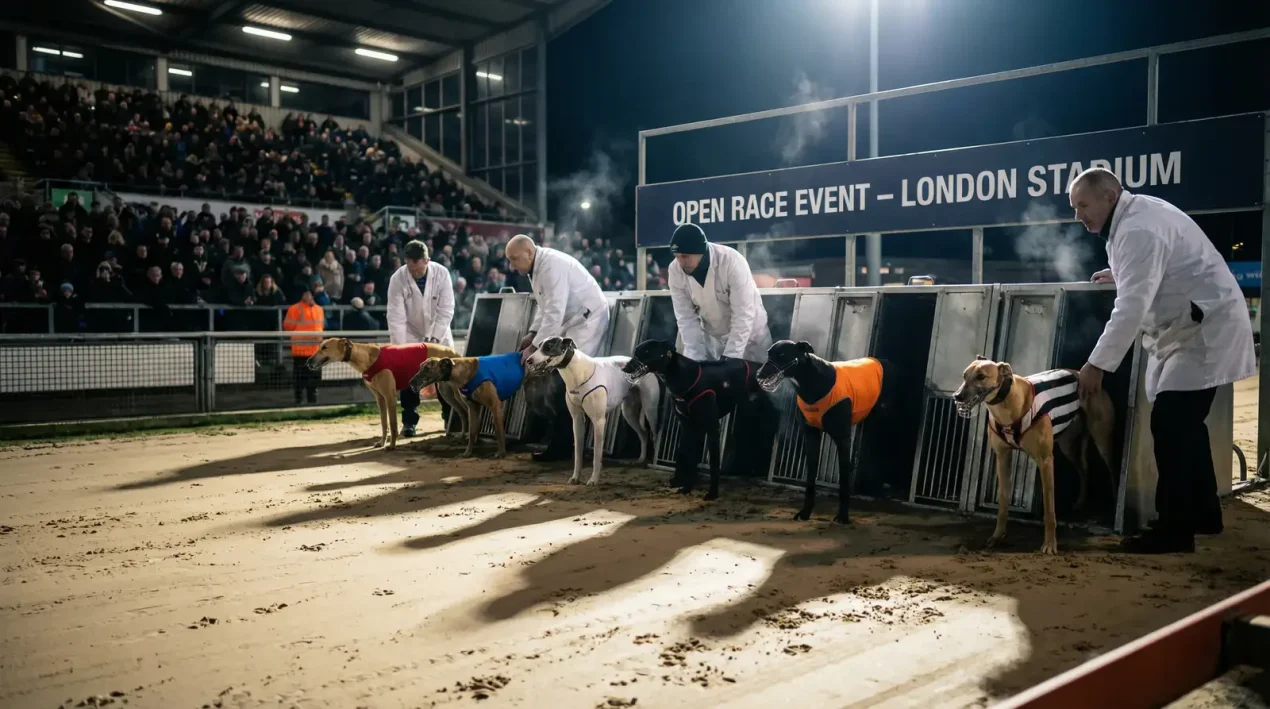
Contents
Two Racing Formats, Two Betting Realities
Not all greyhound races are built the same way. The majority of UK fixtures are graded races — dogs sorted into ability bands from A1 to A11, competing against similarly rated rivals in seeded traps. Open races discard that framework entirely. There are no grade restrictions, the draw is typically random, and the fields often bring together dogs from different tracks and different competitive levels. The two formats demand different analytical approaches, and punters who apply graded-race logic to open races — or vice versa — are working with the wrong map.
How Graded Racing Works: Predictability and Form Reliability
Graded racing is the foundation of the UK greyhound calendar. Dogs are assigned grades based on their recent performances at a specific track and distance, and races are assembled from dogs within the same or adjacent grades. The racing manager handles the trap draw, seeding each dog into a trap that suits its running style — railers on the inside, wide runners on the outside, middle seeds in between.
This structure creates two qualities that benefit bettors: predictability and reliable form data. Because dogs are matched against similar opposition and drawn into appropriate traps, recent form at the same grade and distance is a strong predictor of future performance. A dog that has been finishing first and second in A4 races over 480 metres at Romford is likely to remain competitive in the same context next week. The variables are controlled enough that form analysis works as intended.
The seeded draw is particularly significant. In a graded race, the racing manager’s trap allocation reflects their assessment of each dog’s running style. Trap 1 contains the strongest railer. Trap 6 is the widest runner. This means the trap draw is working with the dogs rather than against them, and first-bend dynamics are shaped by intelligent seeding rather than chance. The result is racing that flows more predictably — which is exactly the environment where form-based betting produces the most consistent results.
The limitations of graded racing, from a betting perspective, are the margins. Because the fields are competitive and the dogs are reasonably well matched, finding clear-cut selections is harder. The form-based edge is real but often small, and the bookmaker’s margin in graded markets can be tight enough that modest analytical advantages are eroded by the overround. Value in graded racing comes from grade drops, trap-draw exploitation and careful reading of recent form at the specific track and distance — marginal gains applied consistently, rather than dramatic insights.
Open Races: Random Draws, Higher Class, More Chaos
Open races operate without grade restrictions. The fields are composed of nominated entries — often the best dogs at a track, or dogs invited from other venues for prestige events. The draw is typically random rather than seeded, which means a confirmed railer might end up in trap 6 and a wide runner in trap 1. The mismatch between running style and trap position introduces a layer of unpredictability that graded racing deliberately minimises.
The random draw is the single biggest difference between the two formats, and it has cascading effects on race dynamics. In a graded race, first-bend traffic is managed by the seeding — each dog is in a trap that allows it to run its natural style. In an open race, the random draw can create first-bend chaos: two railers fighting for the same inside line, a wide runner trapped on the rail with nowhere to go, a slow starter drawn between two fast breakers and squeezed out of contention. These disruptions make finishing positions less predictable and reduce the reliability of pre-race form analysis.
The quality of the fields is generally higher. Open races attract dogs graded A1 or above, and feature events like track championships or invitational competitions draw the best available talent. The times are faster, the margins are tighter, and the dogs are less forgiving of positional errors. A bump at the first bend that a mid-grade dog might recover from can be decisive at open-race level because every dog in the field has the ability to capitalise.
Open races also feature dogs from multiple tracks more frequently than graded events. A dog that has been dominating A1 at Sheffield might contest an open at Nottingham, where it has no course form and no known response to the track’s geometry. These cross-track runners add uncertainty — they may be supremely talented but disadvantaged by unfamiliarity, or they may adapt immediately and outclass the home-track regulars. Either way, their inclusion makes the form picture less complete.
Adjusting Your Approach by Race Type
In graded races, lean on form. Recent finishing positions at the same track, distance and grade are your primary tool. Trap-bias data is highly relevant because the seeded draw means dogs are positioned to run their style, and historical bias patterns apply with reasonable consistency. Grade drops and promotions are the main value triggers. Stick to the process, trust the data, and accept that the edges are small but genuine.
In open races, shift your weight towards pace analysis and trap-draw impact. Because the draw is random, knowing which dogs have early speed becomes more important than their finishing positions in seeded races. A fast breaker drawn in trap 1 in an open race has a structural advantage that doesn’t exist in the same way in graded racing, because the dog in trap 1 of a graded race was placed there because it’s a railer — in an open race, it might be there by lottery. Identifying which dogs benefit from the random draw and which are disadvantaged by it is the primary analytical task.
Forecasts and tricasts tend to offer better value in open races than in graded ones. The increased unpredictability means that unusual finishing orders are more common, and the dividends for those unusual combinations are correspondingly larger. If you can identify three or four dogs with legitimate chances — accounting for the draw — a combination forecast or permutation tricast can produce returns that graded racing’s more orderly outcomes rarely deliver.
Be prepared to pass on open races where the draw has produced an unreadable situation. If three front-runners have drawn in traps 1, 2 and 3, the first-bend dynamics are impossible to predict with confidence. In those races, the honest answer is that you don’t have an edge, and the correct bet is no bet at all.
Know the Format Before You Set the Strategy
The first thing to check when you open a race card is whether you’re looking at a graded race or an open. The information is there — the grade designation, the draw method, the quality of the field — but it’s easy to overlook if you’re moving quickly through a card. Applying graded-race form analysis to an open race will mislead you. Applying open-race scepticism to a well-seeded graded race will cause you to pass on bets you should be taking.
Both formats offer value. They just offer it in different places and reward different types of analysis. Recognise which format you’re betting into, adjust your method accordingly, and you’ll find that the two types of racing complement each other rather than competing for your attention.
Find more race guides at greyhoundbettingtipsuk.
Also read our greyhound grading system.
