
How to Pick a Winning Greyhound
Best Greyhound Betting Sites – Bet on Greyhounds in 2026
Loading...
Contents
Selection as a Structured Process
Picking a winning greyhound is not an act of intuition. It’s a process of elimination that starts with six runners and narrows the field based on evidence. The dogs that look attractive on a race card don’t always carry the strongest case when you examine the detail, and the dogs that the market overlooks sometimes have the best combination of form, draw and conditions in their favour.
The process works through layers. No single factor reliably predicts the winner in isolation — trap draw matters, but a well-drawn dog with poor form won’t win. Recent form matters, but a dog in good form from a terrible draw might not overcome the geometry of the track. Weight changes, trainer records, and the specific conditions of the race surface all contribute to the picture. The skill is in weighing these factors against each other and arriving at a probability assessment, not a certainty.
What follows is a structured approach to evaluating the six key variables that most consistently separate likely contenders from the rest of the field.
Early Speed and Trap Draw
The first bend in a greyhound race is the most influential moment. The dog that leads into it, or at least secures a clean run through it, has an advantage that compounds through the rest of the race. Early speed — measured either by sectional times to the first bend or by visual evidence from recent race replays — is the single most predictive factor in races up to 480 metres.
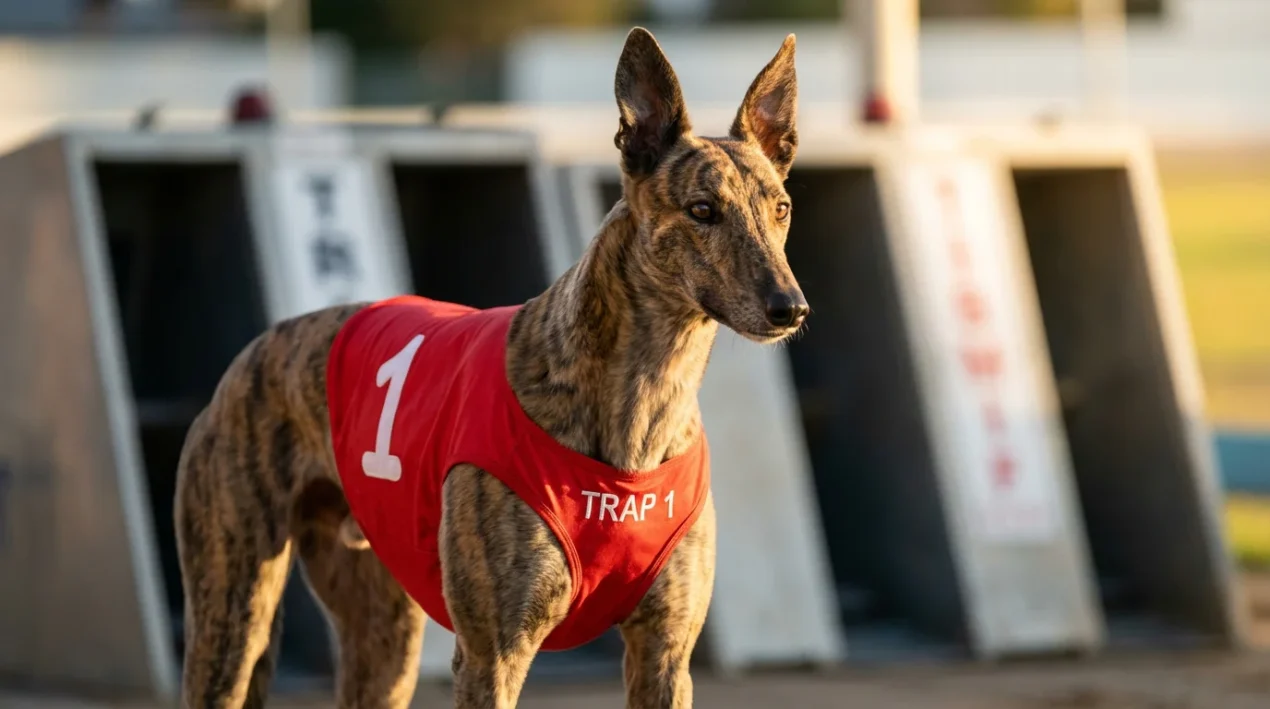
Early speed intersects directly with trap draw. A fast breaker from trap 1 at a track with a short run to the first bend is in an almost ideal position: it can reach the rail quickly, set the pace into the bend, and force rivals to run around it. The same fast breaker from trap 6 has a longer path and more traffic to negotiate. When a dog’s early pace matches its trap position — fast starters on the inside, wide runners with sustained pace on the outside — the configuration gives it a structural advantage that exists before form even enters the equation.
When assessing early speed, look at the first-bend sectional time if available, or failing that, whether the dog’s comment lines mention “led,” “disputing lead,” or “slow away.” A pattern of slow starts from a dog drawn inside is a red flag. Conversely, a dog that consistently shows early pace but has been drawn wide may have been disadvantaged in recent results, and a move to an inside trap could unlock a better performance.
Recent Form and Grade Level
Recent form — the last four to six finishing positions — tells you what a dog has been doing under competitive conditions. A string of first and second places indicates a dog in peak form. A string of mid-field finishes suggests either declining ability, unsuitable conditions, or a temporary dip in fitness. The key is context: where those runs happened and at what grade.
Grade level is the overlooked variable that changes the meaning of form figures entirely. A dog finishing third in an A2 race is running against significantly stronger opposition than one finishing first in an A6. If that A2 dog drops into an A3 or A4 race, its recent form may look mediocre — two thirds and a fourth — but the class differential means it’s been competing above the level of tonight’s field. These grade drops are among the most reliable scenarios in greyhound racing, and the market doesn’t always price them correctly because the raw form figures look unimpressive at a glance.
Conversely, be cautious about dogs that have just been promoted after a win. The grade rise means tougher competition, and many dogs that look brilliant at A5 struggle immediately at A4. First-time-at-grade runs carry inherent uncertainty, and backing a recently promoted dog at short odds is often poor value. Let it prove itself at the new level first.
Weight, Trainer, and Track Conditions
Weight changes between races are published on the race card and deserve more attention than they typically receive. A greyhound gaining a kilogram or more since its last run may be carrying excess condition, which can blunt early speed and reduce stamina over the closing stages. A dog losing significant weight might be overtrained or unwell. The ideal is stability — a dog running at or very near its recent racing weight, suggesting it’s fit and being prepared consistently.
Trainer form adds another dimension. Some trainers run high strike rates at specific tracks, which reflects their understanding of those circuits and their ability to prepare dogs for particular conditions. Others cycle their dogs through regular racing to maintain fitness, while some rest dogs between campaigns and target specific meetings. Over time, you’ll develop a sense of which trainers you trust at your chosen tracks — but initially, checking the trainer’s recent strike rate for the track and distance gives a quick proxy for competence in that context.
Track conditions — surface quality, weather, and rail positioning — affect all six dogs but not equally. Wet tracks can slow early pace and benefit dogs that run on from behind. Rail movements can shift trap bias. And surface maintenance between meetings can change how a track rides from one week to the next. These factors are harder to quantify than form or draw, but they’re worth noting, especially if you’re betting on a track you watch regularly and can spot when conditions have changed from the norm.
Weighing Factors Against Each Other
No single factor wins races alone. The goal is to find the dog where the most factors align — where form, draw, pace, grade, weight and conditions all point in the same direction. That dog doesn’t always exist. Some races are genuinely open, with no clear edge for any runner. In those races, the correct decision might be to pass — not every card requires a bet on every race.
When two dogs look strong on different factors — one has better form but a worse draw, the other has an ideal draw but shakier recent results — the tiebreaker should be the factor most relevant to the track and distance. At tight sprint tracks where the first bend arrives quickly, trap draw and early speed carry more weight. At galloping tracks over longer distances, sustained form and grade class become relatively more important. Match your weighting to the specific context of the race rather than applying a fixed hierarchy.
Build a mental or written ranking of the six runners before looking at the odds. Decide which dog you think is most likely to win, which has the best place chance, and which you’d eliminate entirely. Then check the market. If your top-ranked dog is available at a price longer than your assessment implies, that’s a bet. If the market has priced it shorter than your assessment, it’s a pass. The discipline of separating your analysis from the odds prevents the common trap of reverse-engineering a justification for a dog simply because the price looks appealing.
Selection Is Ranking Probabilities, Not Predicting Winners
The best you can do is identify the dog with the highest probability of winning and assess whether the odds offer value relative to that probability. You will be wrong more often than you’re right — that’s the nature of a six-runner sport where the favourite wins only about a third of the time. The goal isn’t perfection. It’s consistency of method.
Over hundreds of races, a structured process that evaluates early speed, form in context, grade, draw, weight and conditions will outperform gut feeling by a measurable margin. Not on any single race — on any single race, anything can happen. But across a season, the punter with a process and the discipline to follow it has an edge that no tipster, no system, and no amount of luck can replicate.